Inquiry into the misuse/abuse of benzodiazepines and other forms of pharmaceutical drugs in Victoria : final report / Drugs and Crime Prevention Committee.
- Victoria. Parliament. Drugs and Crime Prevention Committee
- Date:
- 2007
Licence: In copyright
Credit: Inquiry into the misuse/abuse of benzodiazepines and other forms of pharmaceutical drugs in Victoria : final report / Drugs and Crime Prevention Committee. Source: Wellcome Collection.
77/524 (page 55)
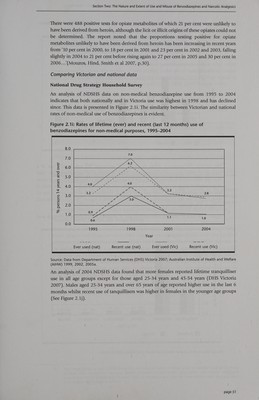
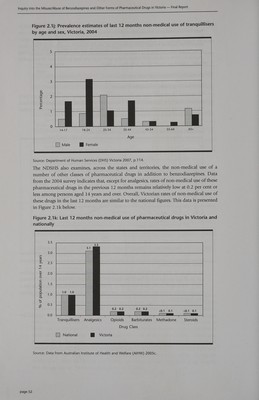
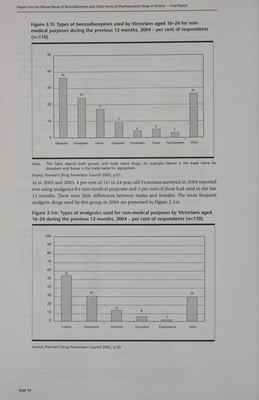
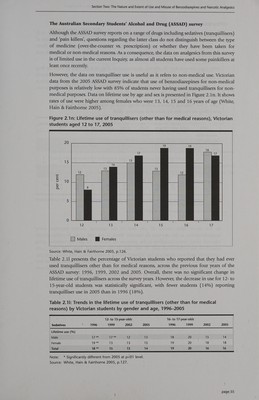
![The Australian Secondary Students’ Alcohol and Drug (ASSAD) survey Although the ASSAD survey reports on a range of drugs including sedatives (tranquillisers) and ‘pain killers’, questions regarding the latter class do not distinguish between the type of medicine (over-the-counter vs. prescription) or whether they have been taken for medical or non-medical reasons. As a consequence, the data on analgesics from this survey is of limited use in the current Inquiry, as almost all students have used some painkillers at least once recently. However, the data on tranquilliser use is useful as it refers to non-medical use. Victorian data from the 2005 ASSAD survey indicate that use of benzodiazepines for non-medical purposes is relatively low with 85% of students never having used tranquillisers for non- medical purposes. Data on lifetime use by age and sex is presented in Figure 2.in. It shows rates of use were higher among females who were 13, 14, 15 and 16 years of age (White, Hain & Fairthorne 2005). Figure 2.1n: Lifetime use of tranquillisers (other than for medical reasons), Victorian students aged 12 to 17, 2005 20 per cent _ ° [|] Males [ Females Source: White, Hain & Fairthorne 2005, p.126. Table 2.11 presents the percentage of Victorian students who reported that they had ever used tranquillisers other than for medical reasons, across the previous four years of the ASSAD survey: 1996, 1999, 2002 and 2005. Overall, there was no significant change in lifetime use of tranquillisers across the survey years. However, the decrease in use for 12- to 15-year-old students was statistically significant, with fewer students (14%) reporting tranquilliser use in 2005 than in 1996 (18%). Table 2.11: Trends in the lifetime use of tranquillisers (other than for medical reasons) by Victorian students by gender and age, 1996-2005 12- to 15-year-olds 16- to 17-year-olds Sedatives 1996 1999 2002 2005 1996 1999 2002 2005 Lifetime use (%) Male 175% 1 Ai 12 13 18 20 15 14 Female 19ise 13 13 15 19 20 18 18 Total 18 ** 15 13 14 19 20 16 16 a EE ESE ERNE EE EE NY | EFI ROSES ES EES BS DES EE IO OILS IEE LEDG ELLE GED LE LOD ILE FAR PARE DLA EI \EAPE ES Note: * Significantly different from 2005 at p<01 level. Source: White, Hain & Fairthorne 2005, p.127.](https://iiif.wellcomecollection.org/image/b32221666_0077.jp2/full/800%2C/0/default.jpg)