Illustrations of some of the principal diseases of the eye : with a brief account of their symptoms, pathology, and treatment / by Henry Power.
- Meneses, Henry Power
- Date:
- MDCCCLXVII [1867]
Licence: Public Domain Mark
Credit: Illustrations of some of the principal diseases of the eye : with a brief account of their symptoms, pathology, and treatment / by Henry Power. Source: Wellcome Collection.
Provider: This material has been provided by UCL Library Services. The original may be consulted at UCL (University College London)
24/690
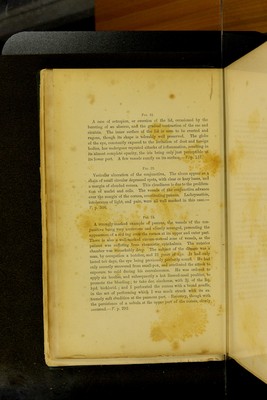
![A case of ectropion, or eversion of the lid, occasioned by the bursting of an abscess, and the gradual contraction of the sac and cicatrix. The inner surface of the lid is seen to be everted and rugous, though its shape is tolerably well preserved. The globe of the eye, constantly exposed to the irritation of dust and foreign bodies, has undergone repeated attacks of inflammation, resulting in its almost complete opacity, the iris being only just perceptible at its lower part. A few. vessels ramify on its surface— V. p. 137. Fig. 23. Vesicular ulceration of the conjunctiva. The ulcers appear as a chain of small circular depressed spots, with clear or hazy bases, and a margin of clouded cornea. This cloudiness is due to the prolifera- tion of nuclei and cells. The vessels of the conjunctiva advance over the margin of the cornea, constituting pannus. Lachrymation, intolerance of light, and pain, were all well marked in this case.— V, p. 306. Fig. 24. A strongly-marked example of pannus, the vessels of the con- junctiva being very numerous and closely arranged, presenting the appearance of a red rag over the cornea at its upper and outer part. There is also a well-marked circum-corneal zone of vessels, as the patient was suffering from rheumatic ophthalmia. The anterior chamber was remarkably deep. The subject of the disease was a man, by occupation a batcher, and 21 years of age. It had only lasted ten days, the eye being previously perfectly sound. He had only recently recovered from small-pox, and attributed the attack to exposure to cold during his convalescence. He was ordered to apply six leeches, and subsequently a hot linseed-meal poultice to promote the bleeding; to take dec. cinchona*, with ?.]. of the liq. hyd bichlorid. j and I perforated the cornea with a bread needle, in the act of performing which I was much struck w.th its ex- tremely soft condition at the pannous part. Recovery, though wi h the persistence of a nebula at the upper part of the cornea, slowly occurred.—V. p. 292.](https://iiif.wellcomecollection.org/image/b21284891_0024.jp2/full/800%2C/0/default.jpg)