Annual report of the Commissioner of Public Health to 30th June, 1930 / Queensland.
- Queensland. Department of Public Health
- Date:
- 1930
Licence: Public Domain Mark
Credit: Annual report of the Commissioner of Public Health to 30th June, 1930 / Queensland. Source: Wellcome Collection.
27/28 (page 27)
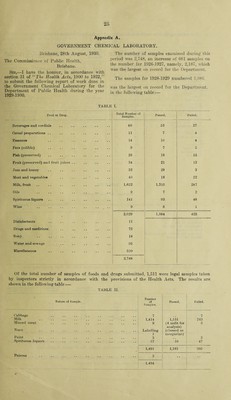
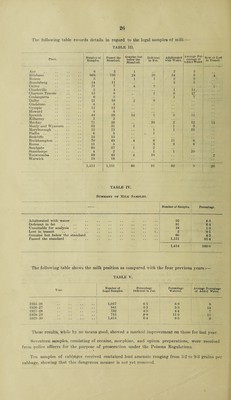
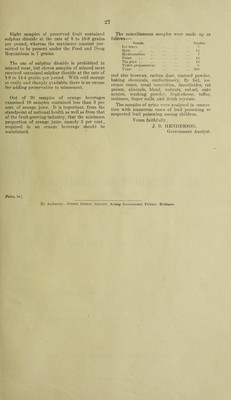
![Eight samples of preserved fruit contained sulphur dioxide at the rate of 8 to 18-9 grains per pound, whereas the maximum amount per¬ mitted to be present under the Food and Drug Regulations is 7 grains. The use of sulphur dioxide is prohibited in minced meat, but eleven samples of minced meat received contained sulphur dioxide at the rate of 1-9 to 144 grains per pound. With cold storage so easily and cheaply available, there is no excuse for adding preservative to mincemeat. Out of 30 samples of orange beverages examined 18 samples contained less than 3 per cent, of orange juice. It is important, from the standpoint of national health as well as from that of the fruit-growing industry, that the minimum proportion of orange juice, namely 5 per cent., required in an orange beverage should be maintained. The miscellaneous samples were follows:— made up as Sample. Number. Ice trays . . 7 Hair 10 Hydrometers . . 7 Paint 16 Tin pipe .. 12 Toilet preparations 9 Urine . . 350 and also beeswax, carbon dust, custard powder, baking chemicals, confectionery, fly foil, ice¬ cream cones, renal concretion, insecticides, rat poison, almonds, blood, walnuts, sul-sol, cake neutro, washing powder, fruit-cheese, toffee, molasses, finger nails, and drink crystals. The samples of urine were analysed in connec¬ tion with numerous cases of lead poisoning or suspected lead poisoning among children. Yours faithfully, J. B. HENDERSON, Government Analyst. Price, Is.] By Authority: Joseph Heeney Stanley, Acting- Government Printer, Brisbane.](https://iiif.wellcomecollection.org/image/b31829478_0027.jp2/full/800%2C/0/default.jpg)