Licence: In copyright
Credit: The laboratory book of dairy analysis / by H. Droop Richmond. Source: Wellcome Collection.
Provider: This material has been provided by the Royal College of Physicians of Edinburgh. The original may be consulted at the Royal College of Physicians of Edinburgh.
87/114 (page 73)
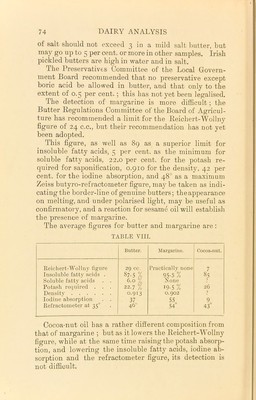
![A standard solution (iwrinal Jlilssigheit) is supplit^d with the instriinient, and the scale should be adjusted from time to time with this; a point is marked on the scale where the standard solution should read, and a key is pi'ovided for adjusting the scale to this. Detection of Sesame Oil.—Add to loc.c. of the melted butter o. ic.c. of a 2 per cent, alcoholic solution of furfural, add ic.c. of sti’ong hydrochloric acid, shake well and add loc.c. of chloroform. A crimson coloura- tion of the aqueous layer indicates sesame oil. Some- times coal-tar colours are added to the butter which give a red colour with hydrochloric acid alone ; make sure of the absence of these by testing a little of the butter with hydrochloric acid. If these are present use the fatty acids (p. 67) for the test. If furfural is not available dissolve o.i gramme of sugar in 5c.c. of hydrochloric acid, and shake with loc.c. of melted fat. This will also give a crimson colour with sesam^ oil. The Application of Analysis to the Solution of Problems. The Detection of Adulteration.—The President of the Board of Agriculture, under his powers authorised by Clause 4 of the Sale of Food and Drugs Act, 1899, has laid down the limit of 16 per cent, of water in butter, and any quantity above this amount is presumed to have been added. Occasionally water has been worked into butter to add to its weight, but a more frequent occurrence of excess of water occurs in milk-blended butter ; in the latter the “ curd” will be in the proportion of i part fur each 10 parts of water, in the former much less. A washed butter may be distinguished from an un- washed one by containing less than i part of curd to 10 parts of water, usually only about 0.5 part; un- washed butter contains about i part; a larger percen- tage of curd indicates that the butter was churned from very sour cream, and will not keep well, or that it has been adulterated with casein. A higher percentage of casein than 0.5 indicates the ]U’esence of added casein ; this form of adulteration is not uncommon. The percentage](https://iiif.wellcomecollection.org/image/b2191980x_0087.jp2/full/800%2C/0/default.jpg)