A universal formulary : containing the methods of preparing and administering officinal and other medicines the whole adapted to physicians and pharmaceutists / by R. Eglesfeld Griffith.
- Robert Eglesfeld Griffith
- Date:
- [1854]
Licence: Public Domain Mark
Credit: A universal formulary : containing the methods of preparing and administering officinal and other medicines the whole adapted to physicians and pharmaceutists / by R. Eglesfeld Griffith. Source: Wellcome Collection.
551/696 (page 545)
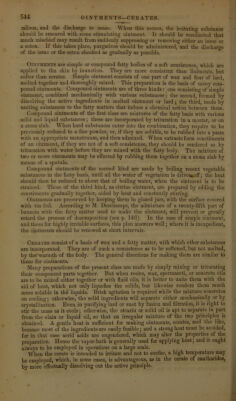
![PLASTERS, Plasters are more consistent than cerates, adhesive at the temperature of the body, and requiring the aid of heat to soften them sufficiently to be spread. They are of two kinds: one consisting of a compound of olive oil and litharge, or an oleo- marearate of lead, having the common lead plaster as a basis, united to resinous or other substances j the other, composed wholly of resinous matters, or these mixed ■with fatty substances or wax. Via. 3i. 1 7M. j 111 ’Apparatus por Spreadino Plasters. [Fig. 34 represents a convenient apparatus for spreading plasters, a c e is a solid block of -wood, rather larger than the intended plaster, and havlng the upper surface cmade slightly convex; b d is a tinned sheet-iron lid to cover the block, to which it is fastened by the hinge r, and farther secured by the clasps seen at d; n is an oblong opening in the cover of the exact size of the plaster; m is a frame for marking the leather into squares. The leather, thus prepared, is piaced on the convex surface p, the lid 6 d is turned down and fastened by the clasps, as seen in the figure i A. The plaster melted in the pan /c is then poured on the leather i, and, by means of the iron instrument ff, is spread uniformly over its surface. When cool, it is separated from the frame by passing the sharp-pointed instrument I around its inner margins.] In making plasters, it is necessary, in most cases, to operate at a temperature that will not volatilize or carbonize the ingredients; hence, a water-bath or steam heat is preferred. In the case of the burnt plaster (onguent de la mere) of the Paris Codex, sufficient heat is employed to cause the fats to fume. Plasters should be made in metallic vessels, much larger than wiU contain the substances to be operated upon, as the mass increases in bulk by the action of heat causing an extrication of vapors. The water ordered in making lead plaster should be added at the com- mencement of the process; otherwise, when poured on the melted mass, it may cause a projection of portions of the heated materials on the operator. The ingre- dients should be thoroughly stirred together during the process of melting. When this operation is concluded, the plaster is to be removed, in small portions at a time, into a vessel constantly supplied with cold water; and, when sufficiently consistent, rolled into cylinders on a wet marble, and again placed in cold water to harden. To render plasters of a lighter color, they are kneaded and pulled under water; but this process should not be practiced on compound plasters containing substances soluble in water; nor should these plasters be cooled in water, but suffered to chill on a marble slab until fit to be made into rolls. Some of the officinal plasters belong to the](https://iiif.wellcomecollection.org/image/b28125678_0551.jp2/full/800%2C/0/default.jpg)