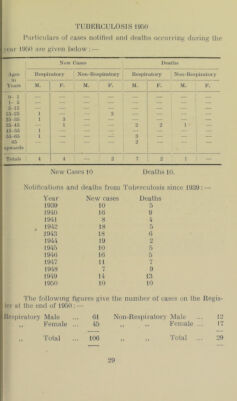
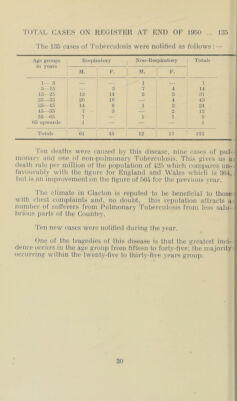
[Report 1950] / Medical Officer of Health, Clacton U.D.C.
- Clacton-on-Sea (England). Urban District Council.
- Date:
- 1950
Licence: Attribution 4.0 International (CC BY 4.0)
Credit: [Report 1950] / Medical Officer of Health, Clacton U.D.C. Source: Wellcome Collection.
33/40 (page 31)
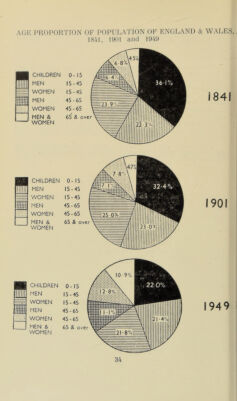
![POPULATION OF ENGLAND AND WALES 1’liere are three factors which determine whether a pojTiiilation shall increase or decrease—the factors of migration, births and deaths. MI ORATION In this country, migration plays only a small part. Hiirriis The rapid increase of the population in the nineteenth cen- tury was accounted for hy the great excess year by year of live births over deaths and by improving survival rates. The annual number of births began to decline after the first decade of the twentieth century, and after the war, apart from 1920 when the maximum number ever recorded (957,782) took place, the decline continued at an accelerated pace to a level of less than ()90,000 annually in the years 1933 to 1935. After these years there was a rise in the total, a trend which was on the whole continued during the late w’ar. After the war the total rose still further, but has been falling since 1947. Tlll^l IRKTH RATE The total number of births is related to the total population for the year to give wiiat is called the birth rate. The highest birth rates were during the period 1865—-1880 when they exceeded 35 per thousand population. From that time it fell practically continuously to a minimum of 14.4 in 1933 when the long decline appears to have been arrested, though in the first years of the late war, 1940 and 1941, it fell even further, the rate of 13.9 in 1941 being the lowest ever recorded. Thus the birth rate had already begun to decline when the total number of births in a year was still rising, and it was a considerable time before its continued fall was reflected in a I eduction in the total of births. DFA'l'HS AND THP] DKATH RATP] The annual totals of deaths have varied much less than those of i)irths, but simili^rly reached a maximum in the closing years of the nineteenth century and have since tended to fall. Iliese totals (as those of births) must he seen against tlio constantly rising population for their significance to be appreciated. i''rom 1870 until now the annual figure has remained fairly steady at about half a million while the population has nearly doublet!, 'riie death rate for the past 30 years is about 12, and lu'oadly speak- ing is half those of a century ago, but furthei' analysis reveals thfit this improvement is very different at varying ages. It has o'-^en](https://iiif.wellcomecollection.org/image/b2911293x_0035.jp2/full/800%2C/0/default.jpg)