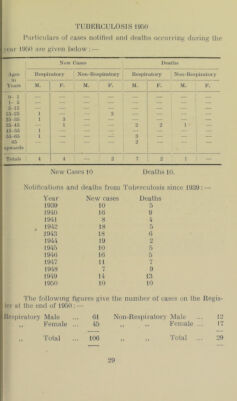
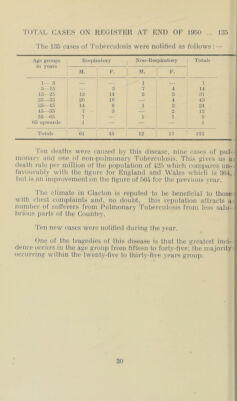
[Report 1950] / Medical Officer of Health, Clacton U.D.C.
- Clacton-on-Sea (England). Urban District Council.
- Date:
- 1950
Licence: Attribution 4.0 International (CC BY 4.0)
Credit: [Report 1950] / Medical Officer of Health, Clacton U.D.C. Source: Wellcome Collection.
34/40 (page 32)
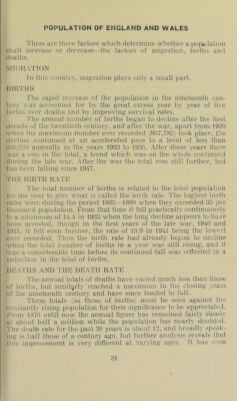
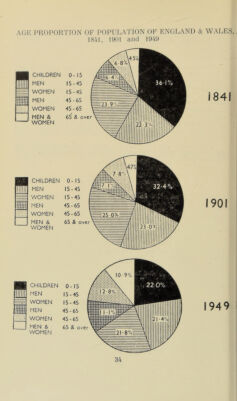
![greatest for children of school age; children under five come next, followed by young adidts. From age 35 the improvement has dim- inished with advancing age so that after age 75 it is very slight. This means that a child of the present day has a far lietter chance of surviving the early years of life than the Victorian child. The infant mortality rate was unchanged up to the turn of the cen- tury ])ut afterwards it declined rapidly until it reached a record low of 29.8 infant deaths under one year of age per 1,000 live births in 1950. This j-ate is still considerably higher than in Sweden, New Zealand, Australia and Holland. In 1948, only seven in every hundred deaths were of children under five years against forty in every hundred a century ago. On the other hand, tlie deaths of persons 65 years of age and over had in the same period increased from 18 to 60 in every hundred deaths. Hoys horn in 1841 could, on average, expect to survive to the age of 40 and girls to 42; by 1948 these average expectations had in- creased to 66 and 71. It may he true to say that the time is not too far off when the ^ death of a school child from any cause other than violence will I)? | a rarity. POPULATION RFPLACFMENT Continuous and adecjuate replacement by new births is es- sential if a population is not to fall below a given level. Potenhal mothers in one generation must produce sufficient girl children to provide an equivalent number of mothers in the ensuing generation. If they fail, a higher ratio must be achieved by the next generation. In 1926 the General Register Office introduced the “Reproduc- tion Rate” which is employed as the index of population replace- ment, for showing the extent to which mothers of one generation are producing more or fewer mothers for the next. The reproduction rate during the nineteenth century was well above the standai'd necessary to maintain the population. By 1922—1923 the rate had ; fallen below the standard and remained j)elow until 1946 and 1947. In these years it rose to 11 per cent, and 20 per cent, above the standard, but for 1950 it has again fallen slightly below the stand- ard . The gain in population from death rates continuing to de- cline is, in future, not likely to be great, and any forecast of the ' future Birth rate is a venture upon uncertain ground. The total4 of births was running steadily in the ten years before the war at ' al)Out 600,000, and if this number were maintained the population i would ultimately be stabilised at about forty-one millions. The average annual number of Ihrths during the last 10 years was about i 700,000, and if such an annual total were maintained, the popula- -](https://iiif.wellcomecollection.org/image/b2911293x_0036.jp2/full/800%2C/0/default.jpg)