Medico-chymical dissertations on the causes of the epidemic called yellow fever : and on the best antimonial preparations for the use of medicine / by a physician, practitioner in Philadelphia.
- Félix Pascalis Ouvière
- Date:
- 1796
Licence: Public Domain Mark
Credit: Medico-chymical dissertations on the causes of the epidemic called yellow fever : and on the best antimonial preparations for the use of medicine / by a physician, practitioner in Philadelphia. Source: Wellcome Collection.
Provider: This material has been provided by the National Library of Medicine (U.S.), through the Medical Heritage Library. The original may be consulted at the National Library of Medicine (U.S.)
34/56
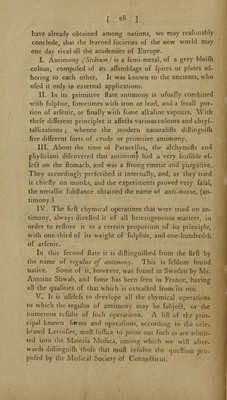
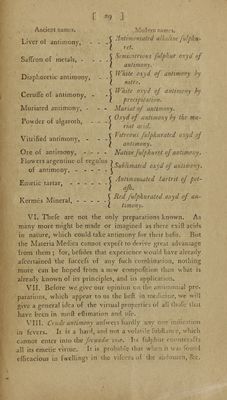
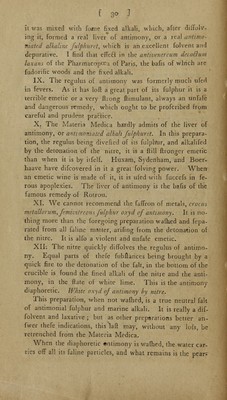
![[ *» ] have already obtained among nations, we may reafonably conclude, that the learned focieties of the new world may one day rival all the academies of Europe. I. Antimony (Stibium) is a femi-metal, of a grey bluifh colour, compofed of an affemblage of fpires or plates ad- hering to each other. It was known to the ancients, who ufed it only in external applications. II. In its primitive ftate antimony is ufually combined with fulphur, fometimes with iron or lead, and a fmall por- tion of arfenic, or finally with fome alkaline vapours. With thefe different principles it affe£ls various colours and chryf- tallizations ; whence the modern naturalifts diftinguifh five different forts of crude or primitive antimony. III. About the time of Paracelfus, the alchymifts and phyficians difcovered that antimony had a very feafible ef- fect on the ftomach, and was a ftrong emetic and purgative. They accordingly prefcribed it internally, and, as they tried it chiefly on monks, and the experiments proved very fatal, the metallic fubftance obtained the name of anti-moine, (an- timony.^ IV. The firft chymical operations that were tried on an- timony, always diverted it of all heterogeneous matters, in order to reftore it to a certain proportion of its principle, with one-third of its weight of fulphur, and one-hundredth of arfenic. In this fecond ftate it is diftinguifhed from the fit ft by the name of regulus of antimony. This is feldom found native. Some of it, however, was found in Sweden by Mr. Antoine Shwab, and fome has been feen in France, having all the qualities of that which is extra6ted from its ore. V. It is ufelefs to develope all the chymical operations to which the regulus of antimony may be fubjeft, or the numerous rcfults of fuch operations. A lift of the prin- cipal known hfrms and operations, according to the cele- brated Lavoifier, muft fuffice to point out fuch as are admit- ted into the Materia Mcdica, among which we will after- wards diftinguifh thofe that muft refolve the qucftion pro- pofed by the Medical Society of Connefticut.](https://iiif.wellcomecollection.org/image/b21146093_0034.jp2/full/800%2C/0/default.jpg)