On the myology of Hyrax capensis / by James Murie and St. George J. Mivart.
- Murie, James.
- Date:
- [1865]
Licence: Public Domain Mark
Credit: On the myology of Hyrax capensis / by James Murie and St. George J. Mivart. Source: Wellcome Collection.
Provider: This material has been provided by The Royal College of Surgeons of England. The original may be consulted at The Royal College of Surgeons of England.
12/24 (page 340)
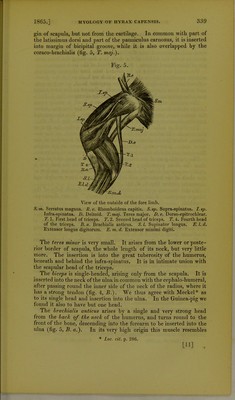
![its homologue in the Pig and Horse; but the Guinea-pig presents us also with the same structure. The coraco-brachialis comes from the rudimentary coracoid pro- cess, and is inserted into the humerus from the lesser tuberosity down to quite the middle of the shaft, in a line along the inner mar- gin of the bicipital groove. It lies in front of the teres major. We found the triceps to be divided into four distinct portions, without counting the small muscle which we have called the dorso- epitrochlear. The first of these, or scapular head, is very strong, and arises from the neck of the scapula, adherent to the teres minor and infra-spinatus. It has an insertion into the olecranon (fig. 5, T. 1). The second, which corresponds to the outer head, is nearly equal in size to the former. It arises from the neck of the humerus, below the teres minor, just behind the greater tuberosity. It is also inserted into the olecranon and outer condyle of the humerus (fig. 5, T. 2). The third or inner head is much smaller than either the first or the second. It arises from the inner side of the neck of the hu- merus, below the brachialis anticus, and below the insertion of the teres major, intervening between these two muscles at its origin. The insertion of this third portion is into the inner side of olecranon. The fourth part of the triceps is much smaller and also short&r than the three preceding; it arises in common with the last, but is clearly separated from it below. It covers the posterior surface of the shaft of the humerus, and is inserted into the inner condyle and olecranon process (fig. 5, T. 4). Meckel does not appear to have observed our fourth belly of the triceps proper. What he calls the fourth is our dorso-epi- trochlear. The dorso-epitrochlear is a long and very narrow muscle. The origin is very different from that of the muscle usually described under this name. We found it to arise from the lower border of the infra-spinatus, and to be inserted into the olecranon by a strong tendinous fascia (figs. 4 & 5, D. e.). The supinator longus is exceedingly diminutive, and arises from the outer side of the shaft of the humerus, just above the common origin of the next two muscles, and is inserted into the radius near its neck (fig. 5, S. L). The presence of the supinator longus is interesting, inasmuch as it is wanting in the Pig and Horse, as also, according to Meckel, in the Hare, Porcupine, Agouti, Beaver, Rat, &c* The extensor carpi longior and brevior were not quite separated as described by Meckel t, but the two had a common origin from the external condyle of the humerus, a little above the carpus giving rise to two distinct tendons. They have an insertion, the one into the metacarpal bones of the index, and the other into metacarpal bones of the middle digits. ^ The extensor communis digitorum arises between the last-men- tioned muscle, and divides into two fleshy bundles which give origin to four flat tendons, one being inserted into each of the four digits. * Lac. cit. p. 304. t Loc. cit. p. 208. * [12]](https://iiif.wellcomecollection.org/image/b22286731_0014.jp2/full/800%2C/0/default.jpg)