On the myology of Hyrax capensis / by James Murie and St. George J. Mivart.
- Murie, James.
- Date:
- [1865]
Licence: Public Domain Mark
Credit: On the myology of Hyrax capensis / by James Murie and St. George J. Mivart. Source: Wellcome Collection.
Provider: This material has been provided by The Royal College of Surgeons of England. The original may be consulted at The Royal College of Surgeons of England.
8/24 (page 336)
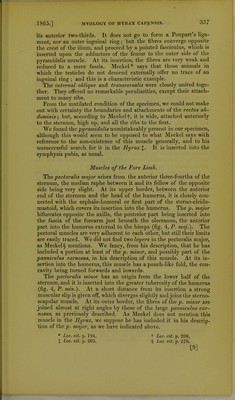
![thickness in the pectoral region. Its attachments are the median line of the back, the median line of the abdomen, anteriorly and above to the fascia covering the scapula. Anteriorly below (where the muscle is thicker) it divides into two separate layers, the deep and much narrower one being inserted into the lesser tuberosity of the humerus, and so intimately connected with the insertion of the pectoralis minor as to be readily confounded with it. The more superficial portion, with its antero-posteriorly directed fibres, covering the front of the thorax, fixes itself so as to be in a manner fused with the obliquely directed fibres of the pectoralis minor at the posterior border of that muscle. The outer portion of this super- ficial layer, however, terminates in a slip, which bifurcates, one part being attached to the fascia covering the biceps in common with a portion of the latissimus dorsi, as above described, the other part being inserted into the inner margin of the bicipital groove of the humerus, in common with the teres major and other portion of the latissimus dorsi (see fig. 4, P. c). The fibres of the posterior part of this muscle (the panniculus carnosus) converge from the back opposite the ilium, and from the lower portion of the abdomen, to form a pyramidal fasciculus, which passes to the lower limb, and is inserted into the superficial aponeurosis of the leg over the knee. Fig. 4. Muscles of the thoracic region. P. maj. Pectoralis major (cut through and turned back). P. mm. Pectoralis minor. S. cl. m. 2. Sterno-mastoid, its second part. 5. sc. Sterno-scapular. C. h. Cephalo-humeral. B. Biceps. T. 1. First portion of triceps. D. e. Dorso-epitrochlear. P. c. Panniculus carnosus. The external oblique is very long, considering the proportions of the animal. It arises from the whole of the ribs, except the three most anterior ones; Meckel * states, from all except the first five. Its other attachments are from the crest of the ilium and linea alba, [8]](https://iiif.wellcomecollection.org/image/b22286731_0010.jp2/full/800%2C/0/default.jpg)