Mineral and aerated waters / by C. Ainsworth Mitchell.
- Mitchell, C. Ainsworth (Charles Ainsworth), 1867-1948.
- Date:
- 1913
Licence: In copyright
Credit: Mineral and aerated waters / by C. Ainsworth Mitchell. Source: Wellcome Collection.
Provider: This material has been provided by The University of Leeds Library. The original may be consulted at The University of Leeds Library.
89/306 page 71
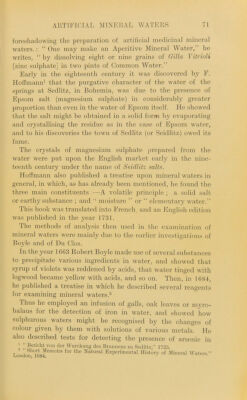
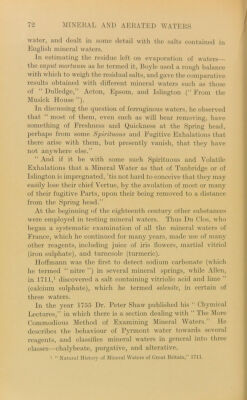
![foreshadowing the preparation of artificial medicinal mineral waters.; “ One may make an Aperitive Mineral Water,” he writes, “ by dissolving eight or nine grains of Gilla Vitrioli [zinc sulphate] in two pints of Common Water.” Early in the eighteenth century it was discovered by F. Hoffmann1 that the purgative character of the water of the springs at Sedlitz, in Bohemia, was due to the presence of Epsom salt (magnesium sulphate) in considerably greater proportion than even in the water of Epsom itself. He showed that the salt might be obtained in a solid form by evaporating and crystallising the residue as in the case of Epsom water, and to his discoveries the town of Sedlitz (or Seidlitz) owed its fame. The crystals of magnesium sulphate prepared from the water were put upon the English market early in the nine- teenth century under the name of Seidlitz salts. Hoffmann also published a treatise upon mineral waters in general, in which, as has already been mentioned, he found the three main constituents :—A volatile principle ; a solid salt or earthy substance ; and “ moisture ” or “ elementary water.” This book was translated into French, and an English edition was published in the year 1731. The methods of analysis then used in the examination of mineral waters were mainly due to the earlier investigations of Boyle and of Du Clos. In the year 1663 Robert Boyle made use of several substances to precipitate various ingredients in water, and showed that syrup of violets was reddened by acids, that water tinged with logwood became yellow with acids, and so on. Then, in 1684, he published a treatise in which he described several reagents for examining mineral waters.2 Thus he employed an infusion of galls, oak leaves or myro- balaus for the detection of iron in water, and showed how sulphurous waters might be recognised by the changes of colour given by them with solutions of various metals. He also described tests for detecting the presence of arsenic in I « ®ericht von der Wurcltung des Brunnens zu Sedlitz,” 1725. T 1 ’ ip„^emoirs for tlle Natural Experimental History of Mineral Waters.”](https://iiif.wellcomecollection.org/image/b2153018x_0089.jp2/full/800%2C/0/default.jpg)
 No text description is available for this image
 No text description is available for this image
 No text description is available for this image