Opium in China / extracted from China; political, commercial, and social.
- Robert Montgomery Martin
- Date:
- [1847?]
Licence: Public Domain Mark
Credit: Opium in China / extracted from China; political, commercial, and social. Source: Wellcome Collection.
27/96 (page 25)
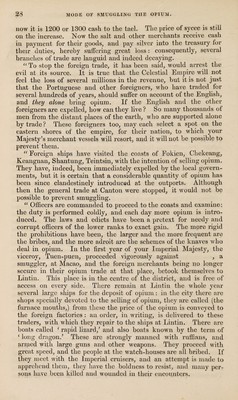
![It is not surprising that the Chinese government became exceed¬ ing anxious to put a stop to a pestilence which, in the emphatic language of Mr. Lay, Her Majesty's consul in China, was “ ham¬ stringing the nation. The Emperor, by his denouncements in 1800, induced the East India Company's supercargoes at Canton, to recommend strongly to the Court of Directors in London, to take measures for preventing the shipment of any opium from Bengal, or from England, to China. In 1809, in the fourteenth year of the reign of the Emperor Leaking, the governor of Canton required the Hong merchants to give bonds of security that all ships, wishing to discharge cargo at Whampoa, had no opium on board. In 1815, Governor Tseang made a report to the Emperor against traitorous natives who dealt in opium at Macao, and re¬ ceived the imperial commands, rigorously to enforce the laws against them. In 1820 (5th of April) Governor Yuen issued a prohibitory pro¬ clamation against the drug. In 1830, the Emperor issued an edict declaring that the “injury done by the influx of opium, and by the increase of those who in¬ hale it, is nearly equal to that of a conflagration, that “ the waste of property and the hurt done to human beings, is every day greater than the precedingand that “ from south to north in all the pro¬ vinces, the appearance of things is as if they were their own ruling rut, [rut of a wheel]. In 1831, the Peking Gazette contained further laws against opium, and inflicted 100 blows and three years transportation, on those who refused to point out the seller of opium. Every governor, Fooyuen, &c., were commanded to require of all persons employed in his office a bond that they never use opium. In 1832, February 9th, Le, governor of Canton province, issued a stringent chop (proclamation or order) against the importation of the “ opium dirt, declaring it “ a spreading poison, inexhaustL ble, and in its injurious effects extreme. The following is a copy of the document Le, cabinet minister, governor, &c. to the Hong merchants re¬ quiring them to inform themselves fully of the following order : “ Opium is a spreading poison,—inexhaustible;—its injurious effects are extreme. Often has it been severely interdicted, as appears on record; but of late the various ships of barbarians, which bring opium, all anchor and linger about at Lintin, in the outer ocean, and exclusive of cargo ships, there are appointed bar¬ barian ships in which opium is deposited and accumulated, and there it is sold by stealth. That place is in the midst of the great ocean, and to it there are four passages and eight communications, (i. e. it is accessible from every quarter.) Not only do traitorous banditti of this province go thither, and in boats make clandestine purchases, but, from many places, in various provinces, vessels come by sea, under pretence of trading to Lintin; and in the dark](https://iiif.wellcomecollection.org/image/b30384990_0027.jp2/full/800%2C/0/default.jpg)