The mechanism of dislocations and fracture of the hip . Litholapaxy, or, Rapid lithotrity with evacuation / by Henry Jacob Bigelow.
- Henry Jacob Bigelow
- Date:
- 1900
Licence: Public Domain Mark
Credit: The mechanism of dislocations and fracture of the hip . Litholapaxy, or, Rapid lithotrity with evacuation / by Henry Jacob Bigelow. Source: Wellcome Collection.
106/372 (page 94)
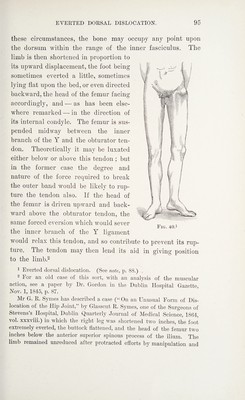
![REDUCTION. After extension by pulleys in the axis of the body has failed, reduction of this luxation has been accomplished by extension downward and outward, with some manipulation of the head of the bone and probably with rupture of the ligament. It is obviously a better plan to unhook the neck by circumduction of the extended limb inward, with eversion enough to disen¬ gage it from the edge of the pelvis. The head then lies upon the dorsum, and if the outer branch of the Y is broken, is not inverted. The reduction may then be accomplished as usual in the dorsal dislocation, although rotation would be less effectual than if the ligament were entire.1 EVERTED DORSAL DISLOCATION. It lias been before stated that inversion of the limb in the dorsal luxations is due to the tense outer branch of the Y ligament. When the injury has been such as to luptuie these fibres, the limb may still be inverted; but it can also be freely everted. Having escaped from the socket under 1 The following case well illustrates the mechanism of the supra¬ spinous luxation, and is taken from Hamilton (“ Practical Tieatise, etc., p. 649) : “ Rente relates a case [of ischiatic luxation] under the care of I)r. Hoffman, in the New York City Hospital, in which, when the extension was suddenly relaxed by cutting the cord, and the thigh at the same instant was abducted and rotated outward, the head of the femur left the ischiatic notch and rose upon the dorsum ilii, assuming a position directly above the acetabulum and below the anterior supe¬ rior spinous process, from which position it was with gieat difficulty subsequently returned to the socket.” If this luxation was really “ ischiatic,” as stated, and therefore “ below the tendon,” the forcible outward rotation of the thigh ruptured both the tendon and the outer part of the Y ligament, or in any case the latter ; after which the head of the bone was free to turn forward and rise on the ilium toward the spine, the limb being of course everted, and the head of the bone perhaps engaged above the remaining ligament.](https://iiif.wellcomecollection.org/image/b31351670_0106.jp2/full/800%2C/0/default.jpg)