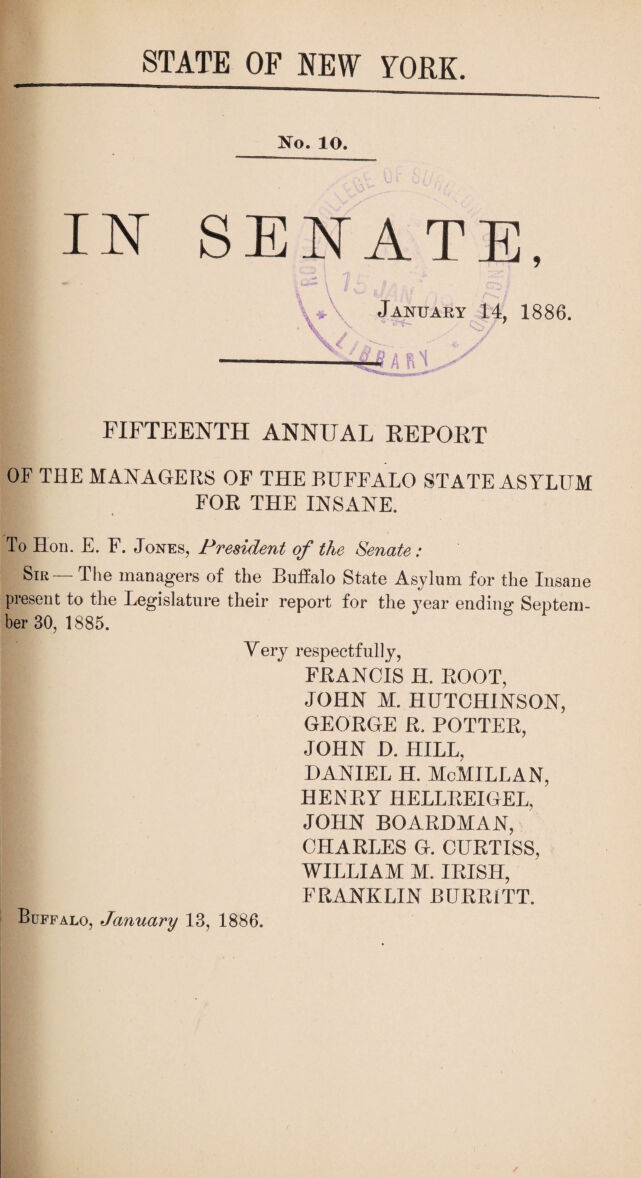
Fifteenth annual report of the managers of the Buffalo State Asylum for the Insane for the year 1885 : transmitted to the legislature January 15, 1886.
- Buffalo State Hospital
- Date:
- 1886
Licence: Public Domain Mark
Credit: Fifteenth annual report of the managers of the Buffalo State Asylum for the Insane for the year 1885 : transmitted to the legislature January 15, 1886. Source: Wellcome Collection.
9/56 page 9
![a ton or in money value, $235, the difference in favor of the soft coal being $80.80. The average gain per day for the twenty-one days is $12.96, or for the month, about $400. From these facts it appears safe to estimate for the five months ot heating season, $2,000 saved, or the entire expense of the appa¬ ratus, cutting boilers and change of smoke-flues. The first week the coal was from the “Gasford” mine, dry in good condition and burned under two boilers. The second week the coal was “ Reynoldsville ” wet, and burned under three boilers one not working up to its full capacity or with perfect combustion’ which accounts perhaps for the falling off of the large gain of the rst week, while the general average, noted later, may not be a dis¬ couraging result in view of the conditions noted. A prominent feature in the use of this soft coal is the small per¬ centage of ashes and waste, which is only ten and one-third percent, while hard coal suffers an average loss of fifteen per cent. As re¬ gards smoke, very little is produced, when there is not too much coal m the furnace, if the grates are properly covered and attended to, but as the whole apparatus and method of using is new to the firemen, we may expect improvements as they become accustomed to the change and know what is required to insure the best results. With regard to the general changes in the entire heating plant and the new method of exhausting air from each building by a sepa¬ rate fan, driven by water in basement, instead of a single fan located in the boiler-room, a thousand feet away, pushing air at the combined buildings, too much cannot be said in favor of the sim¬ plicity and efficiency of the new method and the results obtained over the old. Briefly, the general feature of the ventilating apparatus and the results may be stated as follows: Each building has its own fan and motor which are under perfect control by a single valve in the base¬ ment and capable of driving the fans from fifty to seventy revolu¬ tions per minute, as more or less water is used. At fifty revolu¬ tions of the fans, six feet in diameter, a velocity of 500 feet per min¬ ute is given the air at the discharge openings, which are from ten to twenty square feet, as the size of the buildings demand. Every ten additional revolutions of the fan increases the velocity of the air 100 feet per minute. Thus in the smallest ward, E, the renewal of air is 500x10x60, or equal to 300,000 cubic feet of air removed per hour, or the entire contents of the whole ward or building every thirty minutes. [Sen. Doc. No. 10.] 2](https://iiif.wellcomecollection.org/image/b30318300_0009.jp2/full/800%2C/0/default.jpg)