Volume 1
Cyclopaedia of obstetrics and gynecology / edited by Egbert H. Grandin.
- Grandin, Egbert H. (Egbert Henry), 1855-
- Date:
- 1889
Licence: Public Domain Mark
Credit: Cyclopaedia of obstetrics and gynecology / edited by Egbert H. Grandin. Source: Wellcome Collection.
Provider: This material has been provided by the Royal College of Physicians of Edinburgh. The original may be consulted at the Royal College of Physicians of Edinburgh.
118/544 page 96
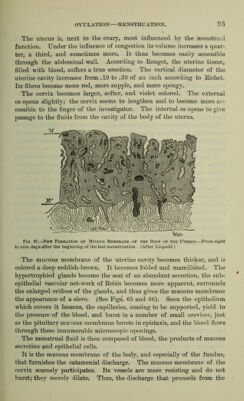
![capillaries. The part taken by the ovaries would then be as passive as that of the uterus, the vagina and the tubes. The theory of Gendrin, Negrier, Bishotf and Coste, is, nevertheless, as yet the classic theory. [In many women who, apparently, do not menstruate, and yet certainly do ovulate, close inquiry will reveal the fact that, while they do not have a periodic red discharge, they do have a periodic white, the so-called white menses. These cases are not rare.—Ed.] First Appearance of the Menses, If, in a number of young girls, the first menstrual hemorrhage appears suddenly, this is far from being the case always. This hemorrhage is usually preceded by malaise and local and general troubles, which may reappear for several months, until menstruation is definitely established. The child, which is to become a woman, each month experiences a weight in the hypo-gastrium, colic and swelling of the breasts; at the vulva there appears white mucous discharges, but it is not until after some time that the true menstrual discharge appears. The first appearance of this dis- charge is subject to the infiuence of a certain number of conditions, which we will successively pass in review. Among these conditions is one that Raciborski called the genital sense, and which he defines as: the greater or less vigor that nature displays in the development of the vesicles of de Graaf. If the menses generally appear in young girls from the twelfth to the sixteenth year, it is not rare to find a much earlier appearance. There are even cases where they have not appeared until the twentieth, twenty-second and even the twenty-fifth year. All writers have shown that very great diflterences exist in the de- velopment of the ovaries in the foetus, and these differences are accent- uated with age, thus impressing corresponding changes upon the menstrual function. Raciborski cites a great number of facts that justify this asser- tion. Among these cases, there is one in which the ovarian activity seemed to begin from the very first years, not to say the first months, after birth, and it is sufficient to recall the cases of Dezeimeris, Comar- mond (de Lyon), Le Beau, d^Outrepont, and Suservind. These cases, which Raciborski characterizes as anomalies, show clearly that, in certain indi- viduals, this genital power is much more developed than in others, and that the menses appear much sooner. Besides these cases of precocious menstruation, there are, on the contrary, women in whom menstruation is delayed, and does not appear for the first time until the twentieth to the twenty-sixth year. There are other cases in which the menses never occur. In these women, the absence of the menses does not absolutely exclude ovarian evolution, hence they may become pregnant, but they are much less apt to be fecundated than women in whom the menses are normal and regular.](https://iiif.wellcomecollection.org/image/b21704867_0001_0118.jp2/full/800%2C/0/default.jpg)