The town child / by Reginald A. Bray.
- Bray, Reginald A. (Reginald Arthur), 1869-1950.
- Date:
- 1911
Licence: In copyright
Credit: The town child / by Reginald A. Bray. Source: Wellcome Collection.
Provider: This material has been provided by The University of Glasgow Library. The original may be consulted at The University of Glasgow Library.
226/264 page 222
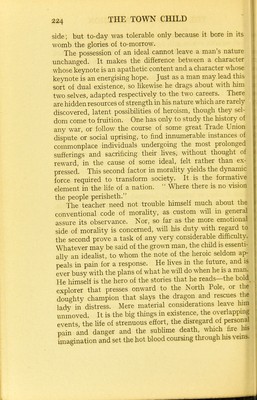
![criticism that the content of the ethical code, whatever the system, remains constant, and that differences of opinion arise only when the writers begin to talk about sanctions and underlying principles. But if religion can boast no peculiar code of its own devising, it at any rate invests that code, which has been derived from other sources, with a characteristic colouring and a distinctive attire. It suppHes a permanent instead of a temporary setting, and insists on a universal in place of a particular application. Rehgion essentiaUy asserts value, creates value, preserves value; and this value belongs to the unlimited and eternal order of things. Here again we touch on that bed-rock difference between the rehgious and the non-rehgious view of the world a difference which makes impracticable in the schools any definite and unsectarian course of moral instruction. In order to realise how widely severed in this respect the methods of teaching must be, it wiU be necessary to mquire a httle more closely into the contents and the origin of the ordinary code of moraUty. This code claims descent from two very dissimilar ancestors. There is, in the first place, what may be called conven- tional morality. At any one time each class of society has its own rules, which must guide the behaviour of its members if thev desire to escape the condemnation of their neigh- bours. Certain acts are awarded praise, others receive blame- while there is a sort of intermediate territory, com- prising the convention, where conduct is accepted as a matter of course and regarded with indifference. Devia- tion from this neutral ground, if in an upward Action i acclaimed with cheers of approval as a sign of f Pf^.^^^f f merit; while, if the tendency is downwards, this fall is taken' as a mark of signal depravity. The contents of this code are the queerest ]umble of the trivial and the significant. From conformity to the funda- mental principles, which alone hold ^°^^^ty/°/^ dictates of Mrs Grundy, all has its appomted p ace m this fantastic museum. The code vanes from age to age and](https://iiif.wellcomecollection.org/image/b21465150_0226.jp2/full/800%2C/0/default.jpg)