Miliary sclerosis : its pathological significance / by W. B. Kesteven.
- William Bedford Kesteven
- Date:
- 1874
Licence: Public Domain Mark
Credit: Miliary sclerosis : its pathological significance / by W. B. Kesteven. Source: Wellcome Collection.
Provider: This material has been provided by The University of Glasgow Library. The original may be consulted at The University of Glasgow Library.
8/14 page 6
![12. Apoplexij with hemorrhagic softenifig, in a portion of ]>rain given me by Dr. Dowse_, Superintendent of the Highgate Metro- politan Infirmary. 13. Infantile convulsions, in a child seven months of age, appa- rently healthy, but having a syphilitic history, suddenly attacked with fatal convulsions. 14. Dementia. A case of chronic mania that had been many years under my observation. 15. General paresis. Of the occurrence of this lesion in general paralysis, I have seen several examples. 16. Malignant disease of the spinal cord. Eor this pathological specimen I am also indebted to the kindness of Dr. Moxon. The preparation had been many years preserved in spirits of wine. It consisted of a small cauliflower growth, proceeding from the lining of the central canal. 17. Glioma of the Fons varolii. The opportunity of examining a portion of a tumour of this kind was afforded me by Dr. Hughlings Jackson. Besides the special structure of the glioma, this tumour presented some examples of the colloid bodies. 18. Internal hcBmorrhagCy the cause of sudden death. A woman aged twenty-five, eight months pregnant, giving way to a violent outbreak of passion, died suddenly. The peritoneal cavity was found to be filled with blood, but the source of haemorrhage could not be found, nor could any change in the vessels be discovered. Miliary sclerosis was found in the brain. 19. Puerperal mania. This case which presented several points of pathological interest, has been already related to the Pathological Society of London. Briefly stated, the principal facts are as follow :—The patient, who had been under my own notice, had borne seven children. After the last four births, she had on each occasion an attack of puerperal mania of a very violent character. In the last she sank from exhaustion. Permission being given, we removed the brain and spinal cord, in both of which abundance of spots of miliary sclerosis were found. I may add, that a very remarkable condition was found in the cord, viz., a total absence of the cells of the posterior vesicular column, for about an inch in extent on the left side of the lower dorsal region. No symptoms existed during life by which attention was drawn to the spinal cord. We are ignorant of the exact functions of this column of cells, but they doubtless have some relation to sensation. 20. In the pages of this Journal, April, 1869, I described ?l new lesion in the medulla oblongata.^' From the description then given. Dr. Tuke recognised miliary sclerosis,''^ and was good enough to forward to me a copy of the paper, above referred to, by Dr. Eutherford and himself, in the ' Edinburgh Medical Journal.' From this I learned the real nature of my new lesion.1 had no](https://iiif.wellcomecollection.org/image/b21481982_0008.jp2/full/800%2C/0/default.jpg)
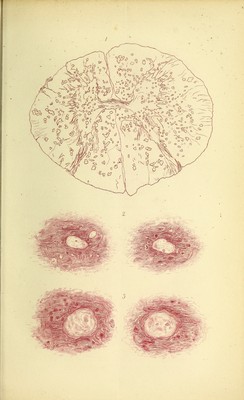

 No text description is available for this image
 No text description is available for this image
 No text description is available for this image