A report on amputations at the hip-joint in military surgery / [by George A. Otis].
- Surgeon General of the United States Army
- Date:
- 1867
Licence: Public Domain Mark
Credit: A report on amputations at the hip-joint in military surgery / [by George A. Otis]. Source: Wellcome Collection.
Provider: This material has been provided by UCL Library Services. The original may be consulted at UCL (University College London)
41/108 page 35
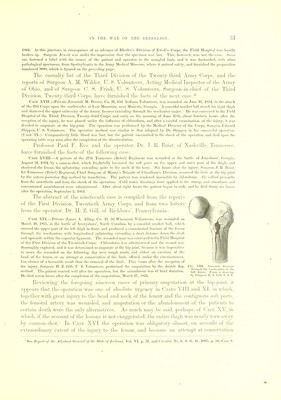
![opinion that amputation at the liip-joint aft'orded the only ])ossible chance of preserving tlie patient's life. Acc<)r<lingly no time was lost. Chloroform was administered by a careful assistant, who habitually discharged this duty at tlie hos])ital. The anrestlietic acted kindly, and an unusual amount was not required. I»r. Del'ruler operated, assisted by Dr. T. N. Myers and others. In consecjuence of the position of the wounds of entrance and exit the ainputation was executed by making- external and internal flaps after Lisfranc's method. The loss of blood was very trifling. After the completion of the operation the pulse, which had been carefully watched, was observed to fail rapidl}'. Unavailing attempts were made to give brandy and other restoratives. In a few moments the man was dead. There was no reason to believe that the use of chloroform had :my connection with the fatal result, which was apparently due solely to the shock of tlie operation. Such was the opinion of the eminent professor of surgery of Jefferson College, Dr. S. D. Gross, who happened to visit the hospital half an hour after the operation. Professor Gross expressed his approbation of the course that had been adopted, since, although it had resulted unfortunately', it afforded the only hope of saving the patient's life. The next case was first rejxjrted to tliis office by Professor Paul P. Eve, of Nasliville, and additional particulars in relation to it were communicated l_)y P)r. James T). Wallis, of Praiikliff, Tennessee, formerly surgeon of the 1st Missouri (Rebel) Pv.ogiment, who witnessed the operation. The operator, Pr. Felton, (PimI in the summer of LS63: Case XXVI.—A private of Colonel Docker.ay's Arkansas (Reliel) Regiment of Cabell's Brigade was wounded at the battle of Corinth, Mississipjii, October 3, 1802. by a conoidal musket ball, which shattered the neck of his right femur. He was conveyed to an hospital at luka, where, on November 3d, his thigh was amputated at the hip-joint by his regimental surgeon. Dr. R. A. Felton. The patient died upon the table before the dressing of the stump was completed. Tlie operation was done under chloroform, and it was the general impression of the surgeons present that the anaesthetic was adminisfereil too freely. The abstract of tlie twenty-seventh case is compiled from a letter from Lieut. Colonel Pineo, Medical Lrspector, U. S. Army, of December 26, 1864, and a memorandum acconi})anyiiig Specimen No. 710 of the Army Medical Museum. The case is briefly noted in the register of Douglas Hospital: Case XX'VII.—Private P. Johnson, Co. C, 2d Delaware 'Volunteers, was wounded at the battle of Fredericksburg, December 14, 1862, by a conoidal musket ball, which entered the upper part of the right thigh in front and passed out at the nates, having, in its course, divided the femoral artery and perforated the great trochanter. Except that the primary hfemorrhage was slight, little is known of the early history of the case. On December 2r.th, the wounded man was conveyed to Washington, and placed in the Douglas Hospital. On admission, nearly the entire injured limb was gangrenous, and it was believed that the fracture extended into the hip-joint. Brigade Surgeon P. Pineo, U. S. Volunteers, in charge of the hospital, decided to amputate at the hip-joint, with no hope of a favorable result, but to mitigate patient's distress in the last moments of life. On December 27th, anEeesthesia being induced by ether, the operation was performed. The patient survived it only a few hours. The pathological specimen was sent to the Army Medical Museum, and exhibits a jierforation of the great trochanter, with radiating fissures, which separate the trochanter and neck into foiu- fragments, and run obliquely down the shaft. Traces of the results of periostitis are visible along the shaft. The four following cases were reported to this office by Professor Paul E\'e. Additional particulars regarding cases XXVIII and XXIX were comnumieated Ijy the operators, Drs. Orymes and Kinloch:- Case XXVIII.—A [irivate f General Bragg's army, whose name and military desci-iption are not recorded, a large man, six feet high, of fair complexion, about twenty-six years of age, was wounded on Deeember -28, 18lj2, in a skirmish prior to the battle of Murfreesboro'. A conoidal musket ball i)roduceil a fracture of the trochanter major and neck of tlie femur, with fissures extending within the capsular ligament. The wounded man was placed in a field hospital, and his injured limb was supjiorted in a proper position ; but the local inflammation and constitutional disturbance that ensued were intense, and, on January .5, 1803, it was determined to anqiutate at the hip-joint. The patient being placed under chloroform, the operation was i)erf'oi-uied Fin. X. Perforatiim d' tlio riijlit fomiir by a musket ball. S]ii:c. 71U, A. M. M. * See Cirni.hii- No. 6. S. G. O.. 180,'>, p. W), Case 10.](https://iiif.wellcomecollection.org/image/b21289475_0041.jp2/full/800%2C/0/default.jpg)