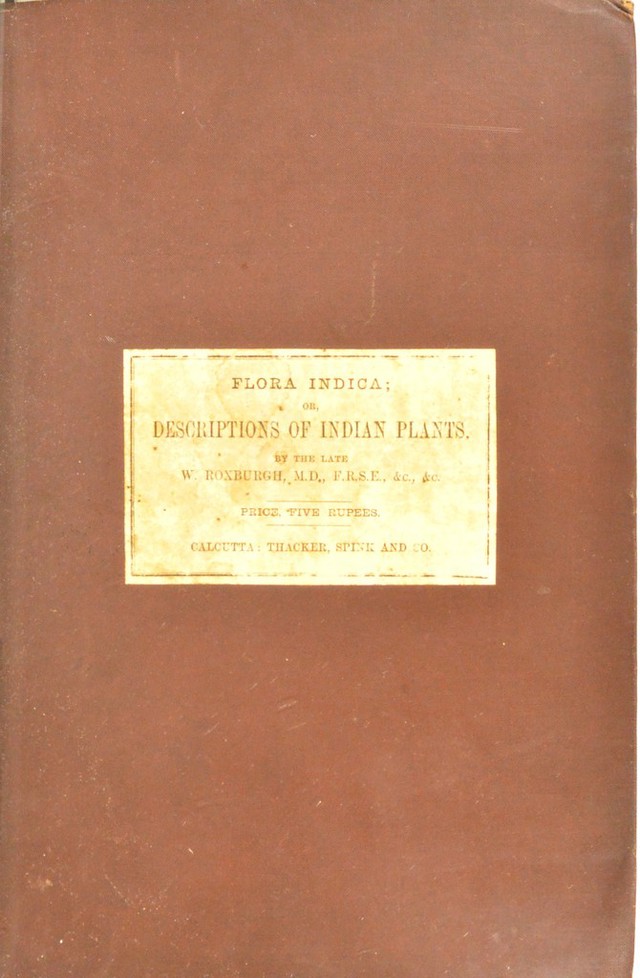
Flora indica, or, Descriptions of Indian plants : reprinted literatim from Carey's edition of 1832 / by the late William Roxborough.
- William Roxburgh
- Date:
- 1874
Licence: Public Domain Mark
Credit: Flora indica, or, Descriptions of Indian plants : reprinted literatim from Carey's edition of 1832 / by the late William Roxborough. Source: Wellcome Collection.
20/844
![G MONAXDTUA MONOOYNIA. Kcempfuria. Carey tube of the corol. Calyx length of the brnctes. Corol ; tube long, filiform ; border double, Ed both three-parted. Exterior divisions linear, acute ; interior, upper two divisions ovate! *• erect; under one expanding, two-parted, with lobes bifid. Filament short, apex two-parted, 10 and recurved. Anther replete with white pollen, crowned with a bidentate crest, or conti- nuation of the_ filament above the anther. Stigma funnel-shaped. Nectarial filaments of Konig two, filiform, erect, pretty long, embracing the lower part of the style. Pericarp; I never saw it ripen. Ob*. The roots possess an agreeable, fragrant smell, and somewhat warm, bitterish, aromatic taste ; the Hindoos use them not only as a perfume, but also medicinally. They are unknown to our best judges in London. 2. K. rotunda. Linn, xp.pl. ed. Willd. 1. 15. Leaves oblong, coloured. Spike radical, appearing before the leaves. Upper segment of the inner border of the corol lanceolar, and acute. Malan-Kua. It heed. Mai. 11. p. 17. t. 9. Sans. Hhoo-ehttmpaca. See Asiat. Res. iv. 242. Peng, and Hind. Bhooi-ehampa or Bhoo-ehamprt. This elegant plant is very generally found cultivated in gardens on account of the beauty and fragrance of its flowers, and though no doubt a native of various parts of India, yet I cannot say where it is indigenous. Flowering time in our gardens March and April, at which period the plant is totally destitute of leaves. Root biennial, tuberous Stem none. Leaves radical, petioled, oblong, waved, smootli* generally coloured underneath ; about a foot long in a good soil, and from four to six inches broad. Petioles sheathing, united into a short stem, us in Curcuma. Scapes just sufficient to elevate the flowers above the earth, embraced by a few common sheaths, of a greenish purple colour. Flowers sessile, from four to six to the scape, or spike, very large, fragrant ; colour of various shades of purple, and white. Bractes two to each flower, sur- rounding the bnse of the germ ; the inner one has its apex two-parted ; the extericy, or longest is here only about half the length of the calyx. Calyx above, one-leaved, as long 1. as the tube of the corol, somewhat gibbous ; apex generally two-toothed, and of a dotted, 17 purplish colour. Corol ; tube long, slender, cyliudric, nearly erect, obliquely funnel-shaped towards the mouth ; border double, both three-parted. Exterior divisions drooping, linear, with margins involute, pure white. Interior border, the two uppermost divisions erect, lanceolar, acute ; colour also white, with the margins slightly tinged with purple j the remaining iuferior one is divided into two broad, obeordnte, deflected lobes, of a deep pur- ple colour, particularly towards the centre, and base. Nectarial filaments of Kiiuig as in K Galanga. Filament short, erect, broad, inserted on the base of the uppermost two interior divisions of the corol. Anther linear, and enlarged with an ovate, two-forked, coloured, somewhat recurved crest Germ ovate. Style filiform. Stigma funnel-shaped. ■Obs. Woodville observes, at page 302 of his Medical Botany, that the roots of Zedo- aria longa, and rotunda are both produced by the same species of plant, and arc indis- criminately used in the shops : the former, he says, are brought to us in oblong pieces, about the thickness of the little finger ; two or three inches in length, bent, rough, and angular ; the latter arc roundish, about an inch in diameter, of an ash colour on the outside, and white within. 1 have never met with any of the roots of this plant that agree with his description of the long sort, and they are too small for the round ; so that 1 must conclude they are the produce of some other plant : at the same time Hr. Woodvilie's observations on the same page, give me reason to think my Curcuma Zedoaria may be the plant, which yields this round sort of Zedoaria. 3. Iv. augustifolia. R. Leaves radical, linear-lanceolate, waved. Spikes hid in the centre of the leaves. Up- per two segments of the inner border of the corol linear, oblong, obtuse. Hind. Kwnjan-boora, also Mad«-uirb*sha. ]. A native of Bengal. Flowering time the rainy season. 18 Root biennial, tuberous, with numerous ramons fibres from every part. Stems none. Leaves radical, numerous, sessile, linear-lanceolate, keeled ; margins entire, and much waved ; striated lengthways, with darker and lighter coloured green, smooth in every part ; from six to eight inches long, and about one broad. Spikes bid in the centre of the leaves, benring from four to six large, beautiful flowers in succession. Bractes two or three to each flower ; one or two interior embrace the germ laterally, the exterior one is larger, all much pointed, and of nearly the same length. Calyx superior, one-leaved, half the length of the tube of the corol. opening obliquely, (spathe-like,) near the apex, which is a single acute point. Corol ; tube very long, and slender, elevating the liorder about two inches above the earth ; border double, &c. ,as in K. rotunda. Nectarial filaments ol kouig, stamens, and pistil as in the last quoted species. Obs. The root is used as a medicine for cattle, by the people of Bengnl. 4. K. pandurata. R. Leaves petioled, broad-lanceolate, smooth. Spike central. Corol, with the upper seg- ments of the inner border obovate, the inferior one much larger, and panduriform. Zerumbet claviculatum. Humph. Amb. 5. p. 172. t. 69. f. 1 ; and I could almost «i- i to quote Manja-kua, It herd. Mai, II. p. 19. t. ii., although referred to already by Lmineus for Curcuma rotunda, a plane I have never met with, if this be not it. From Sumatra, this beautiful plant was sent by Hr. Charles Campbell to the Botauic garden at Calcutta, where it blossoms during the rains, chiefly in August.](https://iiif.wellcomecollection.org/image/b28120024_0020.jp2/full/800%2C/0/default.jpg)


 No text description is available for this image
 No text description is available for this image
 No text description is available for this image