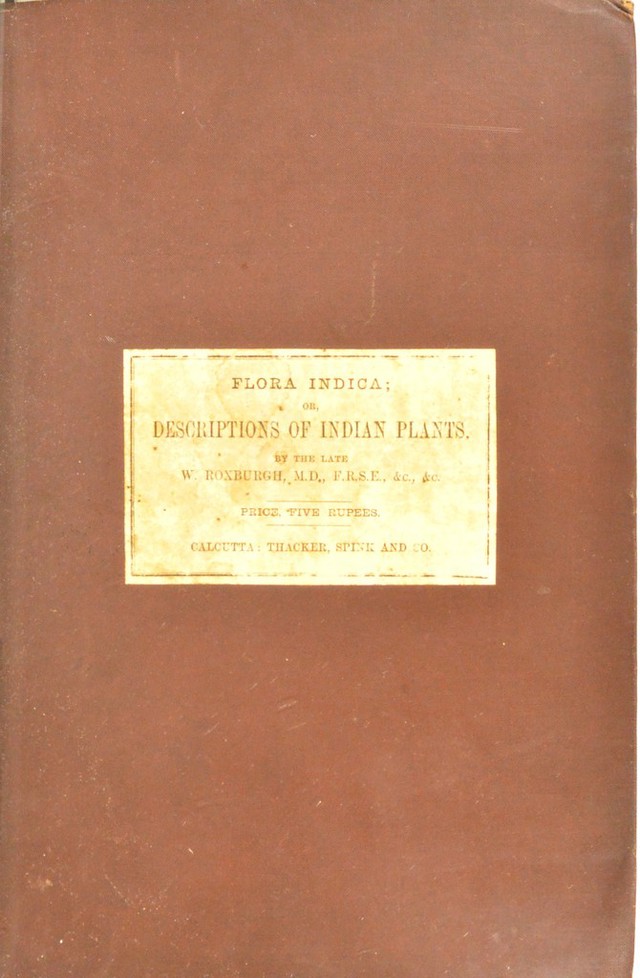
Flora indica, or, Descriptions of Indian plants : reprinted literatim from Carey's edition of 1832 / by the late William Roxborough.
- William Roxburgh
- Date:
- 1874
Licence: Public Domain Mark
Credit: Flora indica, or, Descriptions of Indian plants : reprinted literatim from Carey's edition of 1832 / by the late William Roxborough. Source: Wellcome Collection.
24/844
![cuma. Page loaves ferruginoug-red, with a faint mark of the same colour on the middle of the umier 8ur^ce °f the leaves. A native of Bengal Flowers in April and May. By attending to the pale yellow very fragrant roots, and to the rusty reddish sheaths of the scapes ami leaves, this species will ho 1. readily known. The leaven, as in most of the others, are brood-lanceolur, (that is, they taper 28 equally toward each end,) including the sheaths and petioles, they are four feet high, or more; a very faint ferruginous tinge runs down the middle, which is very conspicuous in those that appear first in the season ; whereas it is scarcely to be observed in the latter. Theflowers are large, few in number, with the exterior border red, and the inferior deep yell >w. The bractes to the fertile part of the spike ferruginous, those of the coma few, and of a pretty bright crimson colour. 8. C. rubescens. It. Bulbs ovate-lanceolate, and with the palmate tubers inwardly pearl-coloured. Leaves broad lanceolate, on red winged petioles, above the sheaths ; rib red. Scape and scales red. Flowers longer than their bractes. A native of Bengal. Flowering time the months of April and May, soon after whieli the leaves appear ; and decay about the beginning of the cool season, in November. Every part has a strong, but pleasant aromatic smell when bruised, particularly the root. jRoot of several, erect, solid, conical, pale straw or pearl-coloured) powerfully aromatic bulbs, which gave support to the former years foliage, and are strongly marked with the circular scars thereof; from their opposite sides, the scapes and stems of the succeeding year spring, which form similar new lmlbs when those of the former year decay ; but during their existence, there issues round their lower half, a number of strong fleshy filers, many of which end in ovate or sub-cylindrical, pale white, slightly aromatic tubers, which also perish with the original parent bulb. Steins, as in the other species, no other than the united sheaths of the leaves, which like them, decay annually about the month of October, and appear again when the flowers begin to perish in April. Leaves hi furious, (six or eight of them forming I. the above-mentioned stems, of at suit three or four feet in height, leaves included,) petioled on 29 their sheathing base, broad-lanceolate, cuspidate, smooth, strongly marked with parallel veins; of an uniform dark-green, with the nerves or ribs red, from twelve to twenty-four inches long, by five or six broad. Petioles and sheaths channelled, smooth, and of a deep red colour ; a projecting process on the inside marks, in all this natural order, the limit of the sheath, and the beginning of the petiole. Scape radical, lateral, eyliiulric, about six inches long, in- vested in several, dark reddish sheaths. Spike tufted, five nr six inches long, erect. Coma less deeply coloured than in Zcrumbet. Bractes, or scales of the spike exactly as in the other species, each embracing four or five flowers, which expand in succession. Flowers small, bright yellow, rather longer than their bractes, fragrant. Tube of the eorol slender, its mouth completely shut with three villous, yellow glands. Fruit not seen in a rq o state. Ohs. The ovate oblong, pendulous tubers of several species of Curcuma, yield a very beautiful, pure starch, like the Arrow-root, produced from Maranta arundinacea and l'acna pinnatijicla, which the natives of the countries where the plants grow, prepare and eat. In Travaneore, where some of these species abound, this flour, or starch, forms, I am told, a large part of the diet of the inhabitants. My ('. angustifolla is another species which yields the same substance ; and I have no doubt but the pendulous tubers of this species yield it also, and equally good. Since writing the above, I have received from Chittagong, Bhagtdpore, and Mirzapore, plants of three other sorts, all employed for the same purpose. 9. C. comosa. It. Bulbs large, oval, inwardly pale ochraeeons. Spikes elevate ; fertile bractes of a pale pink colour ; coma copious and rosy. Leaves broad-lanceolar ; a faint ferruginous cloud above the middle of the earliest ones ; every other part green, j \ native of Burma. From Rangoon Mr. Felix Carey sent plants to the Botanic garden 30 at Calcutta, where they thrive well, and blossom in May, at which time it Ls by far the most beautiful, and the largest of the genus, I have yet seen. Bulbs very large, oval, inwardly of a pale oclmieous colour. Palmate tubers scarcely any. Pendulous tubers lanceolar, and connected to the bulb by uncommonly long, thick, fibrous cords. Leaves bifarious, petioled on their sheaths, lanceolar, smooth, and green in every part, except in those which appear first in the season, which have a faint ferruginous cloud on the centre of the upper surfiiee beyond the middle ; from two to throe feet long; the petioles with their sheathing bases measuring about as much more, making the whole height of the plant five or six feet. Spikes lateral, appearing rather before the leaves, short- scaped, large, clavate. Fertile bractes of a beautiful pale pink. Barren ones of the coma a dee]), lively, rosy red ; on account of the beauty and size of this part, I have given it the trivial name comosa. CoroI with the exterior border pink ; inner pale yellow. 10. C. leucorrhiza. It. Bulbs ovate ; plamale tubers long and far-spreading, like the former they are inwardly of a pale straw colour. Leaves petioled, broad-lanceolar, smooth, of an uniform green in every part. Spikes few-flowered, with a coma as long as the fertile portion. ‘A native of the forests of Bahar. From Bliagulpore Mr. John Glass, the surgeon of that station, sent roots to this garden, under the name Tikor ; and observed flint the plant is not cultivated, but grows in the jungles, to the southward of that place. The process, lie gavs, for obtaining the starchy substance called Tikor, is as follows : “ The root is dug up, aiid’rubbed on a stone, or heat in a mortar, and afterwards rubbed in water with the baud.](https://iiif.wellcomecollection.org/image/b28120024_0024.jp2/full/800%2C/0/default.jpg)