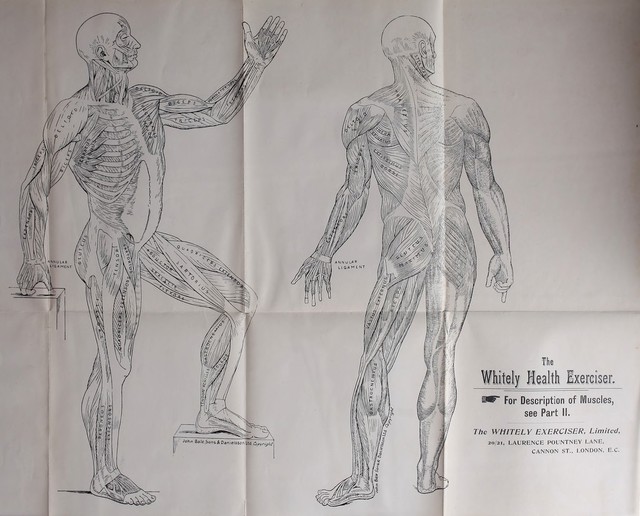
Exercise for health : its science and practice ... containing an anatomical, dumb-bell, and other charts, with full explanations / by H.H. Hulbert and Luis J. Phelan.
- Hulbert, Henry Harper, 1863-
- Date:
- [1898]
Licence: Public Domain Mark
Credit: Exercise for health : its science and practice ... containing an anatomical, dumb-bell, and other charts, with full explanations / by H.H. Hulbert and Luis J. Phelan. Source: Wellcome Collection.
204/276 page 200
![necessary to bring it promptly back again through the veins. This necessary additional force is furnished by the muscles, which, when contracting or hardening, press upon the veins, and force the blood onward towards the heart—always onward, for the veins are supplied with valves like those of a pump, which admit the blood, but will not permit its return in the same direction whence it came.* Muscular activity also accelerates the circulation by drawing the blood to the muscles that are working, and thus relieves congestion of the internal organs. Upon the muscles, this alternate relaxation and contraction while in action has the effect of charging. and re-charging them with fresh blood, and muscle-making material, causing them to rapidly increase in size and strength, hence the necessity of a good blood supply to ensure a healthy muscular development. Moreover, the brain not being a muscular organ, must rely upon bodily activity to draw down the blood that has been used, and make room for new ; for unless the supply of blood to the brain is frequently changed in this way, the organ loses its capacity for vigorous thought, and congestion, headache, insomnia, insanity, etc., are in order. The nervous system (including the brain, the spinal cord, and the nerves) being involved in every muscular action, is kept in good tone by * See Dalton's Physiology, pp. 296, 297 ; Flint’s Text Book of Human Physiology, pp. loi, 102; Kirk’s Hand Book of Physiology, pp. 156, ]57.](https://iiif.wellcomecollection.org/image/b28052080_0204.jp2/full/800%2C/0/default.jpg)