A manual of practical hygiene, for students, physicians, and medical officers / by Charles Harrington.
- Harrington, Charles, 1856-1908.
- Date:
- 1902
Licence: Public Domain Mark
Credit: A manual of practical hygiene, for students, physicians, and medical officers / by Charles Harrington. Source: Wellcome Collection.
Provider: This material has been provided by the Augustus C. Long Health Sciences Library at Columbia University and Columbia University Libraries/Information Services, through the Medical Heritage Library. The original may be consulted at the the Augustus C. Long Health Sciences Library at Columbia University and Columbia University.
770/794 (page 742)
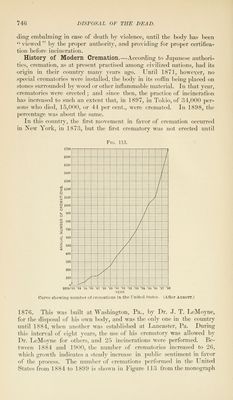
![CHAPTER XVIII. DISPOSAL OF THE DEAD. The public health requires that the bodies of the dead shall be disposed of in such a way as not to be a menace to the living, and as soon as possible, with due consideration of the feelings of those bereaved. In the case of those dead of infectious diseases, disposal should not be delayed by sentimental considerations, but should be accomplished with as little delay as })ossible, on account of the risk to which the living may be subjected by the retention of the body in the home. Concerning methods of disposal, consideration may be limited to the two in use by most civilized peoples and by most others as well; namely, earth-burial and cremation. Earth-burial.—Interment of the dead has ever been the principal mode of disposal among Christians, Jews, and Mussulmans. Within comparatively recent years, the results of overcrowding of ancient churchyards and cemeteries, and the necessity of dedicating great areas of valuable land to be held in j^erpetuity for the accommodation of the dead, have brought about an economic sentiment against the practice, and to it has been added a feeling of danger to the public health from the decomposing tissues, particularly of those who have died of infectious diseases. Buried in soil of suitable character, a body gives otf for a number of months—six to nine may be regarded as reasonable limits—foul gases of decomposition m hich are not evolved in the later stages. The rate of decomposition is influenced not alone by the nature of the soil, its pore volume, and its degree of moisture, but also by the character of the coffin, the depth of interment, and the processes to which the body has been subjected before burial. After some years, the period varying within very Avide limits according to circumstances,^ decomposition is complete and but little remains besides bones, more or less crumbly in character. It is charged against eai'th-burial, that the places used for the ]Hir- pose are oifensive ; that the air becomes poisoned ; that the soil be- comes laden with disease germs of all descriptions, which are pre- served indefinitely, and that water supplies are converted to dilute poisons of great jioteney; that is to say, cemeteries pre(lis])ose to and act as direct causes of disease. As proof, numerous cases which will not bear close scrutiny are cited, but the whole mass of what is 1 See case cited on page 293.](https://iiif.wellcomecollection.org/image/b21219692_0770.jp2/full/800%2C/0/default.jpg)