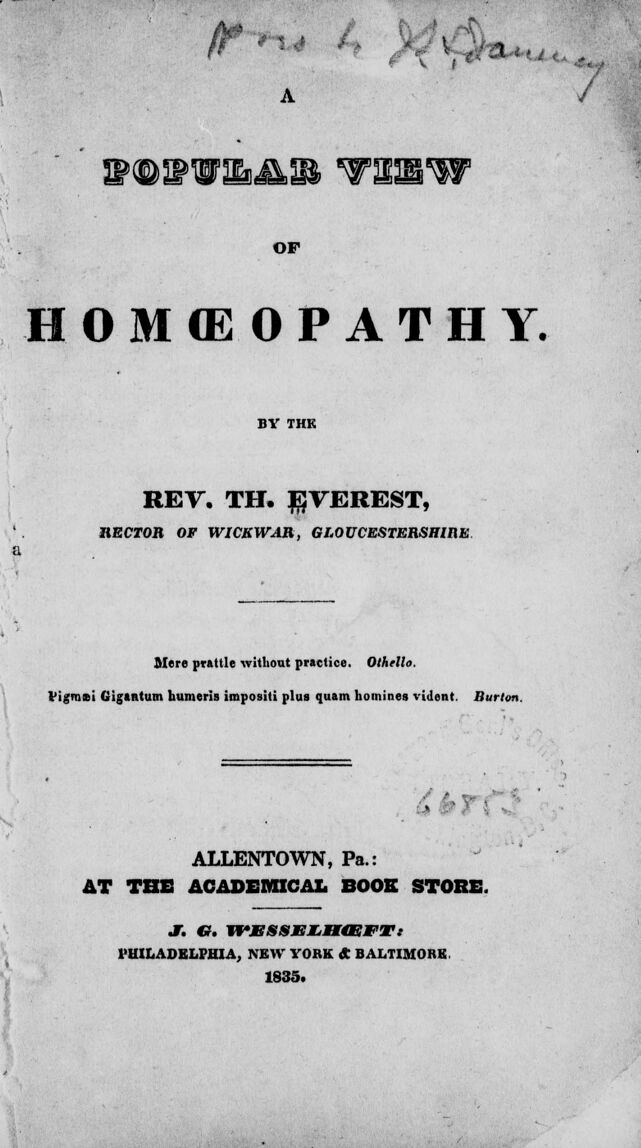
A popular view of homoeopathy / by the Rev. Th. Everest.
- Everest, Thomas R. (Thomas Roupell), -1855
- Date:
- 1835
Licence: Public Domain Mark
Credit: A popular view of homoeopathy / by the Rev. Th. Everest. Source: Wellcome Collection.
Provider: This material has been provided by the National Library of Medicine (U.S.), through the Medical Heritage Library. The original may be consulted at the National Library of Medicine (U.S.)
70/75
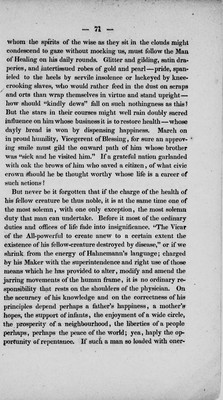
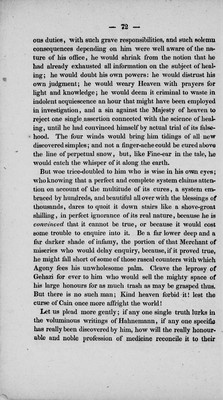
![ever, contains a line unbecoming a gentleman, or a thought unsuited to a Christian, the writer of it would be the first to tear it out if he knew which was defiled by them. Not thus is the dignity of science sustained. Not thus is the cause of truth advanced. If he has endeavoured to make more widely known that which he believes to be true, he cannot think the intention is deserving of blame, however inadequate the exe- cution. If he believes that there is a perfect specific for the cholera, for instance, ought he to keep silence, when every death that has been caused by it is nothing else than pure hom- icide, if Homoeopathy be true] Ought he to hear medical en professing fairly their inability to deal Avith the destroyer and yet keep silence ] Ought he again to see case after case of various diseases happening under his own eye — those cured whom even affection had ceased to hope for — and yet keep silence'? Ought he to mark the light of a great blessing gild- ing the rivers and plains of Germany, quivering on the hill- tops of France and Italy, reflected to the banks of the Hudson, and purifying even the marshes of Surinam, and beautiful England alone overshadowed — the white cliffs of England alone lying in the darkness of the valley of the shadow of death, and yet heep silence? Let it be forgiven him, if he expresses a doubt whether med- ical men in general are properly sensible of the dignity of the office they have undertaken. How proudly ought he to hold his head, who has bent his energies of mind and body to diminish suffering, and who shall be put in competition with him? Tell us not of names and titles, stars and ribands, the mere gold-dust with which man loves to spangle mortality, in order to hide its true complexion — talk not to us of the silken drones who waste their sickly lives in the sleek toil of living — refer us not to the crooked knaveries of little great men, pawning duties in life and hopes in death, to become less greater men by a ballon the coronet or a belt round the knee. He who would see man on his noblest errand — man, on.](https://iiif.wellcomecollection.org/image/b21118462_0070.jp2/full/800%2C/0/default.jpg)
 No text description is available for this image
 No text description is available for this image
 No text description is available for this image