[Report 1925] / Medical Officer of Health, Cockermouth R.D.C.
- Cockermouth (England). Rural District Council.
- Date:
- 1925
Licence: Attribution 4.0 International (CC BY 4.0)
Credit: [Report 1925] / Medical Officer of Health, Cockermouth R.D.C. Source: Wellcome Collection.
30/44 page 28
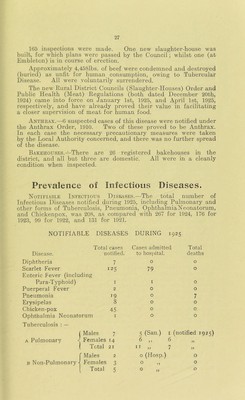
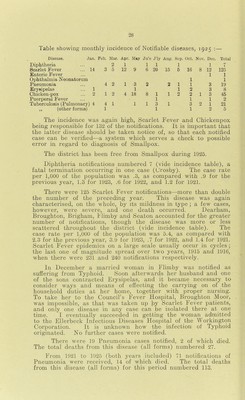
![Table showing monthly incidence of Notifiable diseases, 1925 :— Disease. Jan. Feb. Mar. Apr. May Ju’e J’ly Aug. Sep. Oct. Nov. Dec. Total Diphtheria 2 1 1 1 1 1 7 Scarlet Fever ... 14 3 5 12 9 6 20 15 6 16 8 12 125 Enteric Fever 1 1 Ophthalmia Neonatorum 1 1 Pneumonia 4 2 1 3 2 2 1 1 3 19 Erysipela-s ... 1 1 1 2 3 8 Chicken-pox ... 2 1 2 4 18 8 1 1 2 2 1 3 45 Puerperal Fever 1 1 1 2 Tuberculosis (Pulmonary) 4 4 1 1 1 3 1 3 2 1 21 „ (other forms) 1 1 1 2 5 The incidence was again high, Scarlet Fever and Chickenpox being responsible for 132 of the notifications. It is important that the latter disease should be taken notice of, so that each notified case can be verified—a system wliich serves a check to possible error in regard to diagnosis of Smallpox. The district has been free from Smallpox during 1925. Diphtheria notifications numbered 7 (vide incidence table), a fatal termination occurring in one case (Crosby). The case rate per 1,000 of the population was .3, as compared with .9 for the previous year, 1.3 for 1923, .6 for 1922, and 1.2 for 1921. There were 125 Scarlet Fever notifications—more than double the number of the preceding year. This disease was again characterised, on the whole, by its mildness in type; a few cases, however, were severe, and one death occurred. Dearham, Broughton, Brigham, h limby and Seaton accounted for the greater number of notifications, though the disease was more or less scattered throughout the district (vide incidence table). The case rate per 1,000 of the population was 5.4, as compared with 2.3 for the previous year, 3.9 for 1923, .7 for 1922, and 1.4 for 1921. Scarlet Fever epidemics on a large scale usually occur in cycles; the last one of magnitude spread over two years, 1915 and 1916, when there were 231 and 240 notifications respectively. In December a married woman in Flimby was notified as suffering from Typhoid. Soon afterwards her husband and one of the sons contracted Erysipelas, and it became necessary to consider ways and means of effecting the carrying on of the household duties at her home, together with proper nursing. To take her to the Council’s Fever Hospital, Broughton Moor, was impossible, as that was taken up ]3y Scarlet Fever patients, and only one disease in any case can be isolated there at one time. I eventually succeeded in getting the woman admitted to the Ellerbeck Infectious Diseases Hospital of the Workington Corporation. It is unknown how the infectioni of Typhoid originated. No further cases were notified. There were 19 Pneumonia cases notified, 2 of which died. The total deaths from this disease (all forms) numbered 27. From 1921 to 1925 (both years included) 71 notifications of Pneumonia were received, 14 of which died. The total deaths from this disease (all forms) for this period numbered 113.](https://iiif.wellcomecollection.org/image/b29117719_0030.jp2/full/800%2C/0/default.jpg)