Key-catalogue of insects of importance in public health / by C.W. Stiles and Albert Hassall.
- Charles Wardell Stiles
- Date:
- [1928]
Licence: Public Domain Mark
Credit: Key-catalogue of insects of importance in public health / by C.W. Stiles and Albert Hassall. Source: Wellcome Collection.
11/130 (page 293)
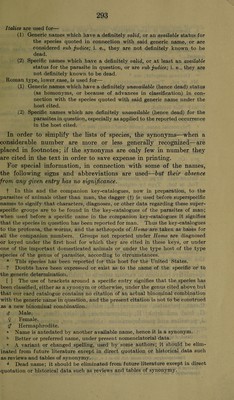
![Italics are used for— (1) Generic names which have a definitely valid, or an available status for the species quoted in connection with said generic name, or are considered sub judice; i. e., they are not definitely known to be dead. (2) Specific names which have a definitely valid, or at least an available status for the parasite in question, or are sub judice; i. e., they are not definitely known to be dead. Roman type, lower case, is used for— (1) Generic names which have a definitely unavailable (hence dead) status (as homonyms, or because of advances in classification) in con¬ nection with the species quoted with said generic name under the host cited. (2) Specific names which are definitely unavailable (hence dead) for the parasites in question, especially as applied to the reported occurrence in the host cited. In order to simplify the lists of species, the synonyms—when a considerable number are more or less generally recognized—are placed in footnotes; if the synonyms are only few in number they are cited in the text in order to save expense in printing. For special information, in connection with some of the names, the following signs and abbreviations are used—but their absence from any given entry has no significance. f In this and the companion key-catalogues, now in preparation, to the parasites of animals other than man, the dagger (f) is used before superspecific names to signify that characters, diagnoses, or other data regarding these super¬ specific groups are to be found in the key-catalogues of the parasites of man; when used before a specific name in the companion key-catalogues it signifies that the species in question has been reported for man. Thus the key-catalogues to the protozoa, the worms, and the arthropods of Homo are taken as bases for all the companion numbers. Groups not reported under Homo are diagnosed or keyed under the first host for which they are cited in these keys, or under one of the important domesticated animals or under the type host of the type species of the genus of parasites, according to circumstances. * This species has been reported for this host for the United States. ? Doubts have been expressed or exist as to the name of the specific or to the generic determination. [ ] The use of brackets around a specific entry signifies that the species has been classified, either as a synonym or otherwise, under the genus cited above but that our card catalogue contains no citation of an actual binominal combination with the generic name in question, and the present citation is not to be construed as a new binominal combination. Male. 9 Female. Hermaphrodite. a Name is antedated by another available name, hence it is a synonym. b Better or preferred name, under present nomenclatorial data. 0 A variant or changed spelling, used by some authors; it should be elim¬ inated from future literature except in direct quotation or historical data such as reviews and tables of synonymy. d Dead name; it should be eliminated from future literature except in direct quotation or historical data such as reviews and tables of synonymy.](https://iiif.wellcomecollection.org/image/b3135743x_0011.jp2/full/800%2C/0/default.jpg)