Licence: Public Domain Mark
Credit: The study of medicine / by S. Cooper. Source: Wellcome Collection.
Provider: This material has been provided by Royal College of Physicians, London. The original may be consulted at Royal College of Physicians, London.
778/788 (page 720)
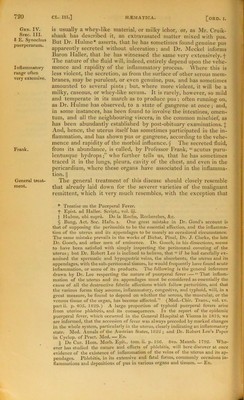
![Gen. IV. Spec. III. 8 E. Synochus puerpcrarum. Inflammatory range often very extensive. Frank. General treat- ment. [ORD. I. is usually a whey-like material, or milky ichor, or, as Mr. Cruik- shank has described it, an extravasated matter mixed with pus. But Dr. Hulme* asserts, that he has sometimes found genuine pus apparently secreted without ulceration; and Dr. Meckel informs Baron Haller, that he has witnessed the same very extensively.]- Ihe nature of the fluid will, indeed, entirely depend upon the vehe- mence and rapidity of the inflammatory process. Where this is less violent, the secretion, as from the surface of other serous mem- branes, may be purulent, or even genuine, pus, and has sometimes amounted to several pints; but, where more violent, it will be a milky, caseous, or whey-like serum. It is rarely, however, so mild and temperate in its march as to produce pus; often running on, as Dr. Hulme has observed, to a state of gangrene at once ; and, in some instances, has been found to involve the intestines, omen- tum, and all the neighbouring viscera, in the common mischief, as has been abundantly established by post-obituary examinations. ]; And, hence, the uterus itself has sometimes participated in the in- flammation, and has shown pus or gangrene, according to the vehe- mence and rapidity of the morhid influence. § The secreted fluid, from its abundance, is called, by Professor Frank, “ acutus puru- lentusque hydropswho further tells us, that he has sometimes traced it in the lungs, pleura, cavity of the chest, and even in the pericardium, where these organs have associated in the inflamma- tion. II The general treatment of this disease should closely resemble that already laid down for the severer varieties of the malignant remittent, which it very much resembles, with the exception that • Treatise on the Puerperal Fever. -f- Epist. ad Haller. Script., vol. iii. ] Hulme, ubi supra. l)e la Roche, Recherches, &c. § Bang, Act. Soc. Hafn. i. One great mistake in Dr. Good’s account is that of supposing the peritonitis to be the essential affection, and the inflamma- tion of tlie uterus and its appendages to be merely an occasional circumstance. The same mistake prevails in the works of Bichat, Pinel, Dr. J. Clarke, the late Dr. Gooch, and other men of eminence. Dr. Gooch, in his dissections, seems to have been satisfied with simply inspecting the peritonacal covering of the uterus; but Dr. Robert I.ee is inclined to believe, that “ if he had carefully ex- amined the spermatic and hypogastric veins, the absorbents, the uterus and its appendages, with the sub-peritona;al tissues, he would frequently have found acute inflammation, or some of its products. The following is the general inference drawn by Dr. Lee respecting the nature of puerperal fever:—“That inflam- mation of the uterus and its appendages must be considered as essentially the cause of all the destructive febrile aflections which follow parturition, and that the various forms they assume, inflammatory, congestive, and typhoid, will, in a great measure, be found to depend on whether the serous, the muscular, or the venous tissue of the organ, has become affected.” (Med.-Chir. Trans., vol. xv. partii. p. 405. 1829.) A large proportion of typhoid puerperal fevers arise iVom uterine phlebitis, and its consequences. In the report of the epidemic puerperal fever, which occurred in the General Hospital at Vienna in 1819, we are informed, that the accession of fever was always preceded by marked changes in the whole system, particularly in the uterus, clearly indicating an inflammatory state. Med. Annals of the Austrian States, 1822 ; and Dr. Robert Lee’s Paper in Cyclop, of Pract. Med. — En. II De Cur. Horn. Morb. Epit., tom. ii. p. 196. 8vo. Mannh. 1792. Who- ever has studied the nature and eflects of phlebitis, will here discover at once evidence of the existence of inflammation of the veins of the uterus and its ajj- pendages. Phlebitis, in its extensive and fatal forms, commonly occasions in- flammations and depositions of pus in various organs and tissues. — En. ii- J](https://iiif.wellcomecollection.org/image/b28268878_0001_0778.jp2/full/800%2C/0/default.jpg)