Dr. Pereira's Elements of materia medica and therapeutics : abridged and adapted for the use of medicine and pharmaceutical practitioners and students and comprising all of the medicines of the British Pharmacopœia, with such others as are frequently ordered in prescriptions or required by the physician / edited by Robert Bently and Theophilus Redwood.
- Jonathan Pereira
- Date:
- 1872
Licence: Public Domain Mark
Credit: Dr. Pereira's Elements of materia medica and therapeutics : abridged and adapted for the use of medicine and pharmaceutical practitioners and students and comprising all of the medicines of the British Pharmacopœia, with such others as are frequently ordered in prescriptions or required by the physician / edited by Robert Bently and Theophilus Redwood. Source: Wellcome Collection.
1064/1132 (page 1032)
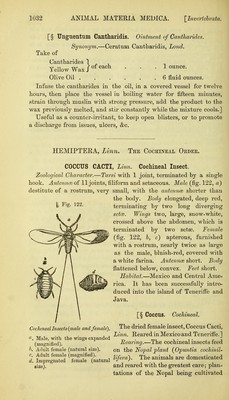
![[§ Unguentum Cantharidis. Ointment of Cantharides. Synonym.—Ceratum Cantharidis, Lond. Take of Cantharides Yellow Wax Olive Oil 6 fluid ounces. Infuse the cantharides in the oil, in a covered vessel for twelve hours, then place the vessel in boiling water for fifteen minutes, strain through muslin with strong pressure, add the product to the wax previously melted, and stir constantly while the mixture cools.] Useful as a counter-irritant, to keep open blisters, or to promote a discharge from issues, ulcers, &c. } of each . . ,1 ounce. HEMIPTERA, Linn. The Cochineal Okdek. I Fig. 122. COCCUS CACTI, Linn. Cochineal Insect. Zoological Character.—Tarn with 1 joint, terminated by a single hook. Antennce of 11 joints, filiform and setaceous. Male (fig. 122, a) destitute of a rostrum, very small, with the antennce shorter than the body. Body elongated, deep red, terminating by two long diverging setce. Wings two, large, snow-white, crossed above the abdomen, which is terminated by two setse. Female (fig. 122, 1), c) apterous, furnished with a rostrum, nearly twice as large as the male, bluish-red, covered with a white farina. Antennce short. Body flattened below, convex. Feet short. Habitat.—Mexico and Central Ame- rica. It has been successfully intro- duced into the island of Teneriffe and Java. Cochineal Insects (male and female). a. Male, with the wings expanded (magnified). b. Adult female (natural size). c. Adult female (magnified). d. Impregnated size). female (natural [§ Coccus. Cochineal. The dried female insect, Coccus Cacti, Linn. Reared in Mexico and Teneriffe. ] Bearing.—The cochineal insects feed on the Nopal plant (Opuntia cochinil- lifera). The animals are domesticated and reared with the greatest care; plan- tations of the Nopal being cultivated](https://iiif.wellcomecollection.org/image/b20412289_1064.jp2/full/800%2C/0/default.jpg)