Dr. Pereira's Elements of materia medica and therapeutics : abridged and adapted for the use of medicine and pharmaceutical practitioners and students and comprising all of the medicines of the British Pharmacopœia, with such others as are frequently ordered in prescriptions or required by the physician / edited by Robert Bently and Theophilus Redwood.
- Jonathan Pereira
- Date:
- 1872
Licence: Public Domain Mark
Credit: Dr. Pereira's Elements of materia medica and therapeutics : abridged and adapted for the use of medicine and pharmaceutical practitioners and students and comprising all of the medicines of the British Pharmacopœia, with such others as are frequently ordered in prescriptions or required by the physician / edited by Robert Bently and Theophilus Redwood. Source: Wellcome Collection.
1066/1132 (page 1034)
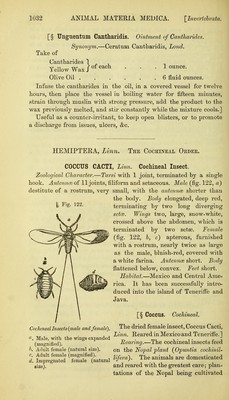
![has a purplish-grey colour; but in all the furrows and depressions we observe a whitish powder, which, examined by the aid of a lens, appears like fine down. This powder is melted by heat and appears to be wax. Silver cochineal, as already noticed, becomes black when warmed be-fore the fire. Black cochineal is reddish- or purplish-black, and devoid or nearly so of the silvery character. An inferior kind of cochineal is called Granilla; this consists of very small cochineal insects, and smaller, wrinkled, globular or ovate masses (cocoons and new-born insects?), somewhat like fragments of the cochineal insect. Adulterations.—An extensive system of adulterating cochineal was practised some years ago. The genuine article was moistened with gum-water, -and then agitated in a box or leathern bag, first with powdered sulphate of baryta, then with bone or ivory-black, to give it the appearance of black cochineal. By this means the specific gravity of the cochineal was increased from 1*25 to 1'35. Powdered talc and carbonate of lead have also been used to give it a silvery appearance. But a lens will readily distinguish these powders from the real down which gives the true silvery character. Composition.—The principal constituent is cochenillin. Cochenillin {carmine).—Obtained by digesting cochineal in ether, to extract the fatty matter, and then in alcohol, which dissolves the carmine. This colouring matter is a brilliant purplish-red substance, with a granular or crystalline appearance ; unalterable in the air, easily soluble in water and alcohol, but insoluble in ether. It fuses at 112° F. Chlorine renders it yellow. Acids change its colour. The* concentrated mineral acids decompose it. Alkalies render the watery solution of carmine violet. Solution of lime forms a violet precipitate with it. The affinity of hydrate of alumina for it is most remarkable ; the compound formed by their union is called a lake. Therapeutics.—It was formerly much used in hooping cough, and it has been reputed, but without the least evidence, to be diuretic, diaphoretic, antispasmodic, and anodyne. The only real value of cochineal is as a colouring agent. Pharmaceutical Uses.—It is an ingredient in compound tincture of cardamom and compound tincture of cinchona. [§ Tinctura Cocci, Tincture of Cochineal. Take of Cochineal, in powder . . . . 2-J ounces. Proof Spirit . . . . . .1 pint. Macerate for seven days in a well-closed vessel, with occasional agitation; strain, press, filter, and add sufficient proof spirit to make one pint.] This preparation is only useful as a red colouring fluid.](https://iiif.wellcomecollection.org/image/b20412289_1066.jp2/full/800%2C/0/default.jpg)