Practical microscopy : a course of normal histology for students and practitioners of medicine / by Maurice N. Miller.
- Miller, Maurice N. (Maurice Norton), 1838-1888
- Date:
- 1891
Licence: Public Domain Mark
Credit: Practical microscopy : a course of normal histology for students and practitioners of medicine / by Maurice N. Miller. Source: Wellcome Collection.
196/248
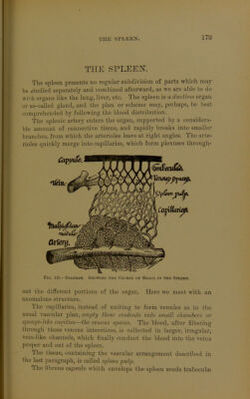
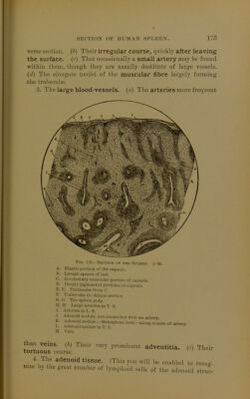
![within, which form a framework; and from this fibrils are sent off which branch, broaden, and inosculate to form the venous chambers of the pul]). The arteries are frequently surrounded by nodules of adenoid tissue, sometimes globular, more frequently considerably elongated, and following the vessel for a considerable distance. These nodules are called Malpighian bodies. They bear no resemblance to simi- larly named structures in the kidney, excepting, perhaps, when seen in transverse section by the naked eye. The spleen will thus be seen to consist of a fibrdus trabeculated framework, the pulp, blood-vessels, and more or less isolated nodules of adenoid tissue. PRACTICAL DEMONSTRATION. The organ must be absolutely free from decomposition. If human tissue cannot be obtained in good condition, recourse may be had to the ox, which will provide an excellent substitute. The small supernumerary spleens, not infrequently found during post- mortem work, are most desirable, as sections can be easily made through the entire organ. Pieces of tissue half an inch cube, including a portion of the capsule, should be hardened as directed for lymph nodes. Sections are easily made without the microtome, as the mass is very firm; they should be thin and stained with borax-carmine, and mounted in dammar or in glycerin. SECTION OF HUMAN SPLEEN, CUT AT RIGHT ANGLES TO AND INCLUDING THE CAPSULE. (Pig. 116.) Observe: (In) 1. The fibrous capsule, (a) Its division into two very dis- tinct portions or layers. (b) The clear translucent appearance of the tissue (elastic) of the outer layer, (c) The darker deep layer with elongate nuclei. (The elastic element of the capsule not infrequently becomes, in the human subject, considerably in- creased; and this development occurs irregularly, sometimes in the form of minute nodules. I do not know that they present any pathological significance.) 2. The trabeculae. (The depth to which they may be traced will depend largely upon the direction of the section.) (a) That these are not bands, but bundles, more or less circular, in trails-](https://iiif.wellcomecollection.org/image/b28116215_0196.jp2/full/800%2C/0/default.jpg)