Volume 1
Catalogue of the African plants collected by Dr. Friedrich Welwitsch in 1853-61.
- British Museum (Natural History) Department of Botany
- Date:
- 1896-1901
Licence: In copyright
Credit: Catalogue of the African plants collected by Dr. Friedrich Welwitsch in 1853-61. Source: Wellcome Collection.
49/392 page 17
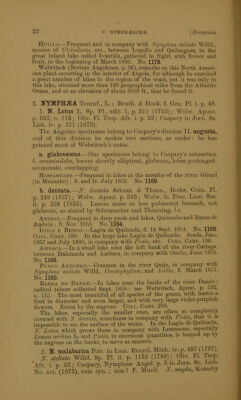
![apiculate connective in the male flower, as well as by the fewer (6) carpels in the female flower. The following extract may refer to this species :— Mucoco— By this name the negroes of Hungo and of Alta Queta (a district of Golungo Alto and the country of the Mahungos) designate a robust creeper of this Order, which in habit much resembles the Abutua [Tiliacom chrysobotrya Welw.], but differs from Abutua in the shape of its leaves, which are cordiform, and by the ferruginous velvet with which its leaves and fruits are covered. The use which the negroes make of this plant, the root as well as the leaves and fruit, is exactly the same as of Abutua, although the latter is reputed by them to be more efficacious, which quality must be attributed to the greater proportion of resin which it contains in almost all its parts (Welw. Synopse p. 46). 4. TRICLISIA Benth. in Benth. & Hook. f. Gen. PI. i. p. 39. 1. T. (?) Welwitschii Hiern, sp. n. A scandent shrub usually decumbent over other shrubs; branches terete, pilose-hispid, twining towards the extremities; leaves ovate, obtuse or mucronate, broadly cordate at the base, thinly coriaceous, tending to rigidity, glabrescent above, with scattered pubescence beneath, entire, 5-7-nerved at the base, 3 to 3| by 2 to 2| in.; petiole patent, pilose-pubescent, 1| to If in., curved near the apex. Male plant unknown. Female flowers greenish, g in. long, broad, on short or unequal pedicels, in axillary cymes scarcely as long as the petiole; sepals 12, obtuse, imbricate, hairy at the back; the 3 outermost very small and nearly equal, the next gradually larger; petals (innermost sepals?) 6, imbricate, small, obovate, glabrous on both surfaces but ciliate round the margin; stamens 0; carpels 4, substipitate, half-ovate, very densely pilose and surrounded by dense pilose hairs; style lateral at the apex, glabrous, erect; fruit unknown. Pungo Andongo.—In very shady places of Mata do Pungo, very rare, only one individual found in flower. No. 2309. In consequence of the male flowers and fruit being unknown, the genus is doubtful ; T. subcordata Oliv. FI. Trop. Afr. i. p. 49, bears a general resemblance to this, but it differs by more numerous carpels as well as by other characters. 5. SYNCLISIA Benth. in Benth. & Hook. f. Gen. PI. i. p. 36. 1. S. scabrida Oliv. ex Miers Contrib. iii. p. 371, t. 148 (1867); Oliv. FI. Trop. Afr. i. p. 49. Golungo Alto.—A climbing shrub or underslirub, with Meni- spermaceous habit, but also resembling Dichapetalum, and in the dry state 8’tggesting Diospyros Barteri Hiern. Leaves opaque-green, dry, rigidly chartaceous. Exterior sepals of the male flowers 6, lanceolate, densely beset outside with elongated hairs ; interior sepals 3, twice the length of the outer, thick-fleshy, almost coriaceous, united in a valvate manner into a cup 3-lobed at the apex, minutely but densely crisped-pilose near the united margins, otherwise glabrous. Stamens 9 ; filaments united at the base ; anthers 2-celled ; cells didymous, longitudinally dehiscing. A bundle of straight hairs in the centre of the filaments](https://iiif.wellcomecollection.org/image/b28120486_0001_0051.jp2/full/800%2C/0/default.jpg)