Volume 1
Catalogue of the African plants collected by Dr. Friedrich Welwitsch in 1853-61.
- British Museum (Natural History) Department of Botany
- Date:
- 1896-1901
Licence: In copyright
Credit: Catalogue of the African plants collected by Dr. Friedrich Welwitsch in 1853-61. Source: Wellcome Collection.
61/392 page 29
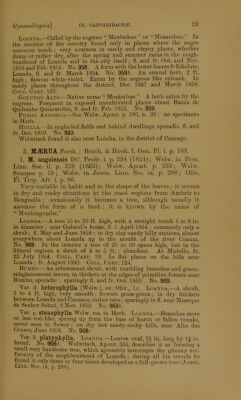
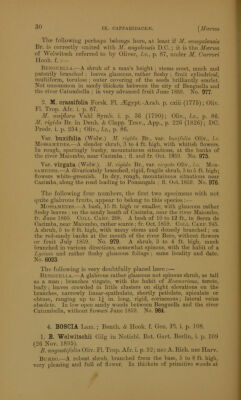
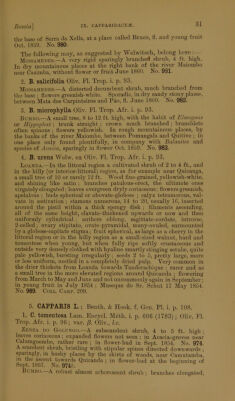
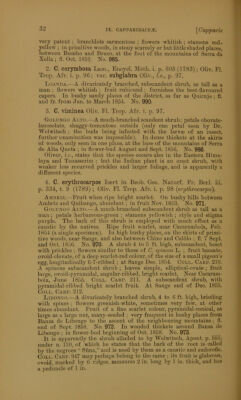
![Gynandropsis] Loan da—Called by the negroes “ Mozembue ” or “ Mozambue.” In the interior of the country found only in places where the negro caravans touch ; very common in sandy and clayey places, whether damp or rather dry, after the spring and summer rains in the neigh- bourhood of Loanda and in the city itself ; fl. and fr. Oct. and Nov. 1853 and Feb. 1854. No. 958. A form with the lower leaves 6-foliolate, Loanda, fl. and fr. March 1854. No. 9586. An annual herb, 2 ft. high; flowers white-violet. Eaten by the negroes like spinach. In sandy places throughout the district, Dec. 1857 and March 1858. Coll. Carp. 163. Golungo Alto.—Native name “ Mozambue.” A herb eaten by the negroes. Frequent in exposed uncultivated places about Banza de Quilombo Quiacatubia, fl. and fr. Feb. 1855. No. 959. PuNGO Andongo.—See Welw. Apont. p. 586, n. 26 ; no specimens in Herb. Huilla.—In neglected fields and behind dwellings, sporadic, fl. and fr. Dec. 1859. No. 980. Welwitsch found it also near Luinha, in the district of Cazengo. 3. MiERUA Forsk.; Benth. & Hook. f. Gen. PI. i. p. 108. 1. M. angolensis DC. Prodr. i. p. 254 (1821); Welw. in Proc. Linn. Soc. ii. p. 329 (1S55); Welw. Apont. p. 555; Welw. Synopse p. 15; Welw. in Jonrn. Linn. Soc. ix. p. 288; Oliv. Fl. Trop. Afr. i. p. 86. Very variable in habit and in the shape of the leaves; it occurs in dry and rocky situations in the coast regions from Ambriz to Benguella; occasionally it becomes a tree, although usually it assumes the form of a bush; it is known by the name of “ Muriangombe.” Loanda.—A tree 15 to 20 ft. high, with a straight trunk 6 to 8 in. in diameter ; near Gabriel’s house, fl. 1 April 1854 ; commonly only a shrub ; fl. May and June 1858 ; in dry clay-sandy hilly stations, almost everywhere about Loanda up to the mouth of the river Coanza. No. 968. In the interior a tree of 25 to 30 spans high, but in the littoral regions a shrub of 4 to 5 ft. ; abundant. At Mutollo, fr. 23 July 1854. Coll. Carp. 99. In flat places on the hills near Loanda ; fr. August 1860. Coll. Carp. 124. Bumbo.—An arborescent shrub, with rambling branches and green- subglaucescent leaves, in thickets at the edges of primitive forests near Bumbo, sporadic ; sparingly fl. and fr. Oct. 1859. No. 969. Yar. 13. heterophylla (Welw.), ex. Oliv., Z.c. Loanda—A shrub, 3 to 4 ft. high, very smooth ; flowers grass-green ; in dry thickets between Loanda and Cacuaco, rather rare; spai’ingly in fl. near Museque de Senhor Schut, 2 Nov. 1853. No. 9636. Yar. y. stenophylla Welw. ms. in Herb. Loanda.—Branches more or less rod-like, sprung up from the base of burnt or fallen trunks, never seen in flower ; on dry hot sandy-rocky hills, near Alto das Cruzes, June 1858. No. 968r. Vir. 8. platyphylla. Loanda.—Leaves oval, 24 in. long by If in. broad. No. 968d. Welwitsch, Apont. 555, describes it as forming a small very handsome tree, which agreeably interrupts the gloomy uni- formity of the neighbourhood of Loanda ; during all his travels he found it only three or four times developed as a full-grown tree (Journ. Linn. Soc. ix. p. 288).](https://iiif.wellcomecollection.org/image/b28120486_0001_0063.jp2/full/800%2C/0/default.jpg)