Volume 1
A treatise on the science and practice of midwifery / by W.S. Playfair.
- Date:
- 1886
Licence: Public Domain Mark
Credit: A treatise on the science and practice of midwifery / by W.S. Playfair. Source: Wellcome Collection.
Provider: This material has been provided by the Royal College of Physicians of Edinburgh. The original may be consulted at the Royal College of Physicians of Edinburgh.
173/442 (page 145)
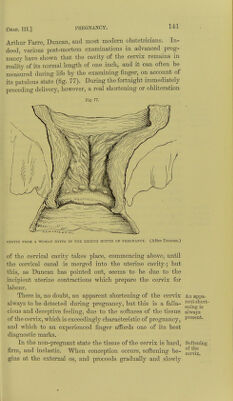
![or eight times during tlie latter months, even when no defi- nite S}Tiiptoms of disease existed ; and many of the older authors record cases where depletion was practised every fortnight, as a matter of routine, and, when the symptoms were well marked, even from fifty to ninety times in the course of a single pregnancy. Numerous careful analyses have conclusively proved that Composi- the composition of the blood during pregnancy is very gene- ][,|°'^^*- rally—perhaps it would not be too much to say always— preg- profouudly altered. Thus it is found to be more watery, its serum is deficient in albumen, and the amount of coloured globules is materially diminished, averaging, according to the analysis of Becquerel and Rodier, 111-8 against 127-2 in the non-gravid state. At the same time the amount of fibrine and of extractive matter is considerably increased. The latter observation is of peculiar importance, as it goes far to explain the frequency of certain thrombotic affections observed in connection with pregnancy and delivery; this hyperinosis of the blood is also considerably increased after labour by the quantity of effete material thrown into the mother's system at that time, to be got rid of by her emunc- tories. The truth is, that the blood of the pregnant woman is generally in a state much more nearly approaching the condition of anemia than of plethora, and it is certain that most of the phenomena attributed to plethora may be ex- plained equally well and better on this view. These changes are much more strongly marked at the latter end of preg- nancy than at its commencement, and it is interesting to obsei-ve that it is then that the concomitant phenomena alluded to are most frequently met with. Cazeaux, to whom we are chiefly indebted for insisting on the practical bearing of these viewsj contends that the pregnant state is essentially analo- gous to chlorosis, and that it should be so treated. More recently the accurate observations of Willcocks' have shown that the blood of pregnancy differs from that of chlorosis m the fact that while in both the amount of h£emoglobin is lessened, in pregnancy the individual blood-cells are not im- povenshed as they are in chlorosis, but simply lessened in comparative number, owing to an increase in the water of ^ 'v'^i'^'^^T^'T ^''^^^•^tio'^s on the Blood in Chlorosis and Pregnancy.' By Fred. Willcocks, M.D., TJie Lancet, December 3, 1881 VOL. I.](https://iiif.wellcomecollection.org/image/b21987968_0001_0173.jp2/full/800%2C/0/default.jpg)