Volume 1
A treatise on the science and practice of midwifery / by W.S. Playfair.
- Date:
- 1886
Licence: Public Domain Mark
Credit: A treatise on the science and practice of midwifery / by W.S. Playfair. Source: Wellcome Collection.
Provider: This material has been provided by the Royal College of Physicians of Edinburgh. The original may be consulted at the Royal College of Physicians of Edinburgh.
77/442 (page 51)
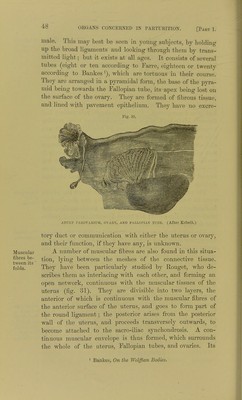
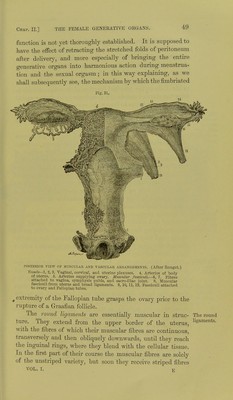
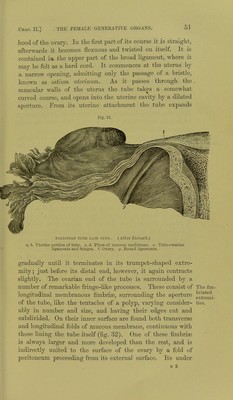
![5] hood of the ovary. In the first part of its course it is straight, afterwards it becomes flexuous and twisted on itself. It is contained in the upper part of the broad ligament, where it may be felt as a hard cord. It commences at the uterus by a narrow opening, admitting only the passage of a bristle, known as ostium uterinum. As it passes through the muscular walls of the uterus the tube takes a somewhat curved course, and opens into the uterine cavity by a dilated aperture. From its uterine attachment the tube expands Fig. 32. FALLOPIAN TUBE LAID orE>j. (After Eicbard.) a, b. Uterine portion of tube, c, d, Plicas of mucous membrjine. e. Tubo-OTaiian ligaments and fringes, Ovary, g. Round ligaments. gradually until it terminates in its trumpet-shaped extre- mity; just before its distal end, however, it again contracts slightly. The ovarian end of the tube is surrounded by a number of remarkable fringe-like processes. These consist of The fim- longitudinal membranous fimbrias, surrounding the aperture g^tremi of the tube, like the tentacles of a polyp, varying consider- ties, ably in number and size, and having their edges cut and subdivided. On their inner surface are found both transverse and longitudinal folds of mucous membrane, continuous with those lining the tube itself (fig, 32). One of these fimbria3 is always larger and more developed than the rest, and is indirectly united to the surface of the ovary by a fold of peritoneum proceeding from its external surface. Its under](https://iiif.wellcomecollection.org/image/b21987968_0001_0077.jp2/full/800%2C/0/default.jpg)