Dr. Pereira's Elements of materia medica and therapeutics : abridged and adapted for the use of medical and pharmaceutical practitioners and students and comprising all the medicines of the British Pharmacopœia, with such others as are frequently ordered in prescriptions or required by the physician / edited by Robert Bentley and Theophilus Redwood ; with an appendix.
- Jonathan Pereira
- Date:
- 1874
Licence: Public Domain Mark
Credit: Dr. Pereira's Elements of materia medica and therapeutics : abridged and adapted for the use of medical and pharmaceutical practitioners and students and comprising all the medicines of the British Pharmacopœia, with such others as are frequently ordered in prescriptions or required by the physician / edited by Robert Bentley and Theophilus Redwood ; with an appendix. Source: Wellcome Collection.
78/1180 (page 46)
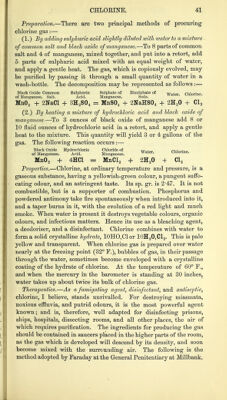
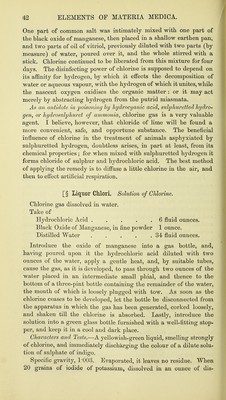
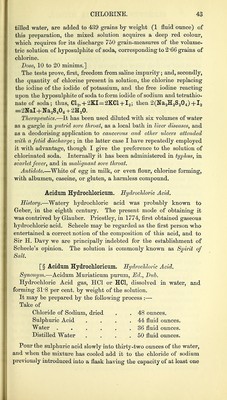
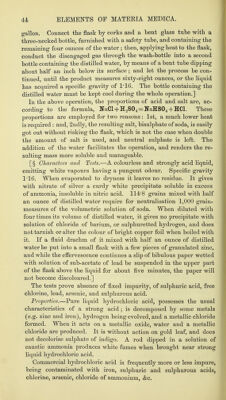
![Weigh the acid in a glass flask, the capacity of which to a mark on the neck is one pint, then add distilled water until the mixture at 60° temperature after it has been shaken, measures a pint. Teste—Specific gravity 1*052. 345 grains by weight (6 fluid drachms) require for neutralisation 1,000 grain-measures of the volumetric solution of soda, corresponding to 10'58 per cent, of real acid. Six fluid drachms contain one equivalent or 36*5 grains of hydrochloric acid, HC1 or HC1. Dose, 10 to 30 minims.] [§ BR0MTJM. Bromine. Br, or Br=80. A liquid non-metallic element, obtained from sea-water and from some saline springs.] History.—Bromine (from /3jO«3/i«c, a stench) was discovered by M. Balard in 1826. It exists in sea-water and many mineral waters, especially brine springs, in combination with either sodium, magne- sium, or calcium. The saline springs near Kreuznach in Germany, are especially rich in it. Bromine has also been found in the sea- plants of the Mediterranean, and in the mother-waters of Kelp. Preparation.—When the mother-liquor of sea-water, or bittern, has been deprived, as much as possible, of its other salts by crystal- lisation, chlorine is developed in it, either by binoxide of manga- nese and hydrochloric acid; or, when the quantity of metallic chloride is sufficient, by binoxide of manganese and sulphuric acid. This decomposes the bromide of magnesium contained in the liquor, and sets free bromine, which distils over; MgBr2 + Cl2 == MgCl2 -f- Br2. The bromine thus obtained requires to be subsequently purified, [§ Characters and Tests.—A dark brownish-red, very volatile, liquid, with a strong and disagreeable odour. Its specific gravity is 2*966. At the common temperature of the air it gives off red vapours, and at a temperature of 117° it boils. Agitated with solution of soda in such proportion that the fluid remains very slightly alkaline, it forms a colourless liquid, which, if coloured by the further addition of a small quantity of the bromine, does not become blue on the subsequent addition of a cold solution of starch.] This last test shows the absence of iodine. When exposed to a cold of —4° F., it is a yellowish-brown, brittle, crystalline solid. Physiological Effects.—The constitutional effects resulting from the continued use of bromine have not been well determined; they are probably intermediate between chlorine and iodine, but, accord- ing to Dr. Grlover, more nearly related to the former than the latter. In small doses it acts as a tonic, diuretic, and resolvent. It is rarely used in the uncombined state, but a solution of one part in](https://iiif.wellcomecollection.org/image/b20392357_0078.jp2/full/800%2C/0/default.jpg)