Licence: Public Domain Mark
Credit: Sales catalogue: R Lier & Co. Source: Wellcome Collection.
10/12 page 6
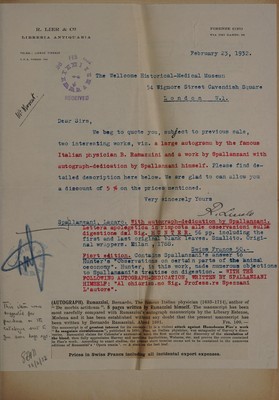
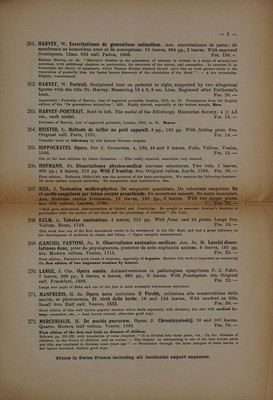
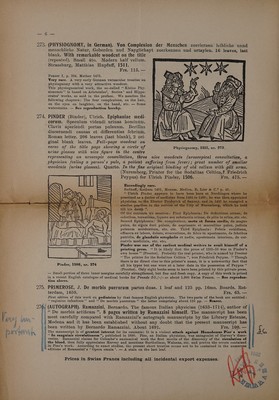
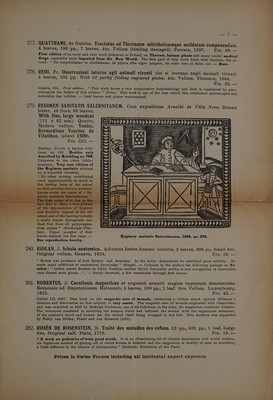
![“2 se ey eee 273. (PHYSIOGNOMY, in German). Von Complexion der Menschen zuerlernen leibliche unnd menschliche Natur, Geberden und Nayglichayt zuerkennen und urtaylen. 16 leaves, last blank. With remarkable woodcut on the title (repeated). Small 4to. Modern half vellum. Strassburg, Matthias Hupfuff, 1511. Frs. 115, — Panzer I, p. 334. Muther 1473. Very rare. A very early German vernacular treatise on physiognomy with a very attractive woodcut. This physiognomical work, the so-called ‘‘ Kleine Phy- sionomie’’ is based on Aristoteles’, Scotus’ and Hippo- crates’ works, as said in the preface. We mention the following chapters: The four complexions, on the hair, on the eyes on laughter, on the hand, etc. — Some waterstains. — See reproduction hereby. PINDER (Binder), Ulrich. Epiphaniae medi- corum. Speculum videndi urinas hominum. Clavis aperiendi portas pulsuum. Berillus discernendi causas et differentias febrium. Roman letter. 206 leaves (last blank), 2 ori- ginal blank leaves. Full-page woodcut on verso of the title page showing a circle of Physiognomy, 1511, nr. 273. urine glasses with nice figure in the centre 4 representing an wuroscopic consultation, three nice woodcuts (uroscopical consultation, a a physician feeling a person's puls, a patient suffering from fever); great number of smaller woodcuis (urine glasses). Quarto. In the fine original binding of old vellum with gilt arms. (Nuremberg, Printer for the Sodalitas Celtica,? Friedrich Peypus) for Ulrich Pinder, 1506. Frs. 475. — Exceedingly rare. : Sudhoff, Ketham 1491, M “ Ulrich Pinder appe _. practised as a doctor of n i A R. Lier & C.° p ia a n bo nat Ne i till his death ’ rea iiss ash. ST is fe is Of the contents we mention: First Epiphania: De definitione coloribus, tornatione, liquore seu substantia urinae, de pilis in urina, etc. et Second Ephiphania: De complexions, motu et forma cordis, de magno pulsu, de signis duri pulsus, de caprisante et marcellino pulsu, judicia pulsuum accidentium, etc. etc. Third Epiphania: Febris cottidiana, effimera ex labore, dolore, evacuatione, de febre in apostemate, de febribus putridis, de glandulis scropholis et nodis, apostemata interiora, de cor- rosivis medicinis, etc. etc. Pinder was one of the earliest medical writers to avail himself of a printing press. ‘‘ It is likely that the press of 1505-10 was in Pinder’s own house ’’ (Proctor). Probably the real printer, who is named by Proctor ‘The printer for the Sodalitas Celtica ’’, was Friedrich Peypus. ‘‘ Though peat there is no direct clue to this printer’s name, it is a noteworthy fact that ta Pinder, 1506, nr. 274 all his types but one were at a later date in the possession of Peypus ”’ % (Proctor). Only eight books seem to have been printed by this private press. — Small portion of three inner margins caréfully strengthened, but fine and fresh copy. A copy of this work is priced Bot in a recent English catalogue of medical books for Pounds 50./-/- = about 1.000 Swiss Francs. — See reproduc- tr tion above. : 275. PRIMEROSE, J. De morbis puerorum partes duae. 1 leaf and 125 pp. 16mo. Boards. Rot- bake. terdam, 1659. Frs. 65. — First edition of this work on pediatrics by that famous English physician. The two parts of the book are entitled: ‘‘yegimine infantium’’ and ‘‘ De morbis puerorum ’’ the latter comprising about 110 pp. — Scarce. (AUTOGRAPH). Ramazzini, Bernardo. The famous Italian physician (1633-1714), author of } © ~ ‘“De morbis artificum ”. 8 pages written by Ramazzini himself. The manuscript has been ai most carefully compared with Ramazzini’s autograph manuscripts by the Library Estense, ,4 Modena and it has been established without any doubt that the present manuseript has ' 4 been written by Bernardo Ramazzini. About 1691. Frs. 100. — J G . The manuscript is of greatest interest for its contents: It is a violent attack against Homobonus Piso’s work ‘In sanguinis circulationem”, published in 1690. Piso, an Italian physician, was antagonist of Harvey’s disco- veries. Ramazzini claims for Colombo’s anatomical work the first merits of the discovery of the circulation of . the blood, then fully appreciates Harvey and mentions Bartholinus, Walaeus, etc. and proves the errors contained in Piso’s work. According to exact studies, the present short treatise seems not to be contained in the numerous editions of Ramazzini’s ‘ Opera omnia’. — A stain on the last leaf. . \\ 7 ff \ l Bae Ney W | A hes aN iia ca ee i) ~] BO: Be a sO Salt Sats boat PORE area SBR ase ans ong Beene](https://iiif.wellcomecollection.org/image/b33158071_0010.jp2/full/800%2C/0/default.jpg)
 No text description is available for this image
 No text description is available for this image
 No text description is available for this image