Licence: Public Domain Mark
Credit: Sales catalogue 467: Maggs Bros. Source: Wellcome Collection.
63/112 page 51
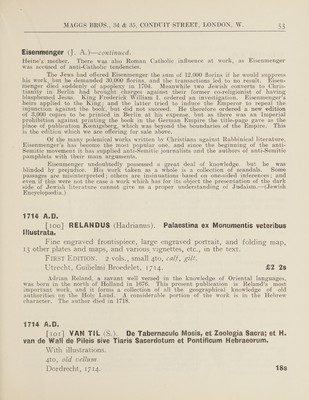
![1760 A.D. [94] Le BRUN (Corneille). Voyage au Levant, c-est a dire dans les Principaux endroits de l’?Asie Mineure, dans les Isies de Ghio, de Rhodes, de Chypre, etc. de méme que dans les plus considerables Villes W@Egypte, de Syrie, et de la Terre Sainte. Magnificent engraved portrait, frontispiece, folding map, 96 fine engraved plates containing about 200 illustrations, including the magnificent large panoramic views of Smyrna, Constantinople, Scutari, Scio, Rhodes, Alex- andria, Bethlehem, Jerusalem, Aleppo, etc., and other engravings in the text. Thick folio, contemporary calf gilt. Delft, Henri de Kroonevelt, 1700. £1 10s [9 5| Que Meyo se podera tomar pera extinguir o Judaismo de Portugal. Composto por mandado de S. Magestade por hum Ministro seu. Small ato, boards. NoP., Np. -[| Lisbon, cirea.1700, | 15s Not in Kayserling or Innocencio. An interesting tract containing suggestions for the extinction of Judaism in Portugal, one of the principal means suggested being the suppression of Jewish religious instruction. 1703 A.D. [90] LEAO TEMPLO (Selomoh Jehuda). Resit Hohma. Principio de Sciencia ou Gramattica Hebrayca. Por hum methodo breve, claro, facil e distincto . . . para‘uzo das escolas como a ensina no Medras em que assiste, no KK. de Talmud’ Torah, 4to, old vellum. Amsterdam, Ymanuel Athias, 5463 (1703). £7 15s Kayserling (p. 58). The author was a Haham at Amsterdam, and has composed a concise grammar for Hebrew scholars. 1704 A.D. [97] GOMEZ (Antonio Enriquez). Academias Morales de las Musas. Dirigidas al Gloriosissimo Santo y nuevo Apostol de las Indias, S. Prancisco Xavier, [imbre esclarecido de la Sagrada Compafia de Jesus. Thick royal 8vo, old vellum. Barcelona, Rafael Figuero, 1704. £1 5s Kayserling (p. 49). This poet was a native of Segovia (late seventeenth century), and was also known by the name of Enrique Enriquez de Paz, son of Diego Enriquez Villanueva. He studied philosophy, history and literature, and at the age of twenty embarked upon a military career. ‘He was persecuted by the Inquisition, “who accused him of the heresy of Judaism, and his effigy was burnt at Seville in 1660. He went to France, where he remained for some years in Bordeaux and Rouen, and where he published some of his earlier works (the book offered herewith being one of his earliest poetical compositions). He died in Holland circa 1662.](https://iiif.wellcomecollection.org/image/b31639227_0063.jp2/full/800%2C/0/default.jpg)
 No text description is available for this image
 No text description is available for this image
 No text description is available for this image