Health effects of exposures to mixtures of air pollutants / Advisory Group on the Medical Aspect of Air Pollution Episodes.
- Great Britain. Advisory Group on the Medical Aspects of Air Pollution Episodes
- Date:
- 1995
Licence: Open Government Licence
Credit: Health effects of exposures to mixtures of air pollutants / Advisory Group on the Medical Aspect of Air Pollution Episodes. Source: Wellcome Collection.
27/140 (page 17)
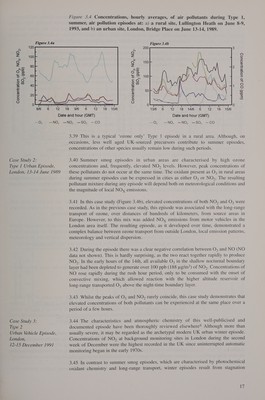
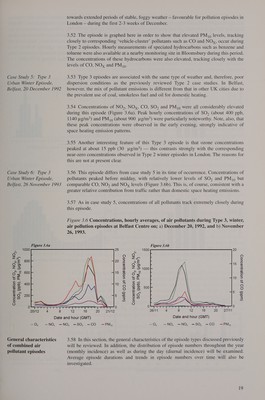
![Figure 3.4 Concentrations, hourly averages, of air pollutants during Type 1, summer, air pollution episodes at: a) a rural site, Lullington Heath on June 8-9, 1993, and b) an urban site, London, Bridge Place on June 13-14, 1989. Figure 3.4a Figure 3.46 120 . 200 3 ay oO Ci ge 100 = S x : fe) Oo 150 3 Zz aE = a et = ifs) oN a 8 O38 me O0e. 4.60 of 100 3 N N £Oo =O = 2a 20 fe) © 40 ro 4 Q i e 50 = 3 20 3 | = = < = 8 5) “] 0 : 0 a 0 86 6 12 18 96 6 12 18 10/6 1396 6 12 18 146-6 12 18 156 Date and hour (GMT) Date and hour (GMT) —-0O,-- —NO, —NO, —SO, —CO -O, —NO, —NO, —SO, —CO 3.39 This is a typical “ozone only’ Type | episode in a rural area. Although, on occasions, less well aged UK-sourced precursors contribute to summer episodes, concentrations of other species usually remain low during such periods. Case Study 2: 3.40 Summer smog episodes in urban areas are characterised by high ozone Type 1 Urban Episode, London, 13-14 June 1989 Case Study 3: Type 2 Urban Vehicle Episode, London, 12-15 December 1991 concentrations and, frequently, elevated NO, levels. However, peak concentrations of these pollutants do not occur at the same time. The oxidant present as O; in rural areas during summer episodes can be expressed in cities as either O, or NO). The resulting pollutant mixture during any episode will depend both on meteorological conditions and the magnitude of local NOx emissions. 3.41 In this case study (Figure 3.4b), elevated concentrations of both NO, and O3 were recorded. As in the previous case study, this episode was associated with the long-range transport of ozone, over distances of hundreds of kilometers, from source areas in Europe. However, to this mix was added NOy emissions from motor vehicles in the London area itself. The resulting episode, as it developed over time, demonstrated a complex balance between ozone transport from outside London, local emission patterns, meteorology and vertical dispersion. 3.42 During the episode there was a clear negative correlation between O3 and NO (NO data not shown). This is hardly surprising, as the two react together rapidly to produce NO,. In the early hours of the 14th, all available O, in the shallow nocturnal boundary layer had been depleted to generate over 100 ppb (188 tg/m>) of NO,. Concentrations of NO rose rapidly during the rush hour period, only to be consumed with the onset of convective mixing, which allowed reaction with the higher altitude reservoir of long-range transported O; above the night-time boundary layer. 3.43 Whilst the peaks of O3 and NO, rarely coincide, this case study demonstrates that elevated concentrations of both pollutants can be experienced at the same place over a period of a few hours. 3.44 The characteristics and atmospheric chemistry of this well-publicised and documented episode have been thoroughly reviewed elsewhere® Although more than usually severe, it may be regarded as the archetypal modern UK urban winter episode. Concentrations of NO, at background monitoring sites in London during the second week of December were the highest recorded in the UK since uninterrupted automatic monitoring began in the early 1970s. 3.45 In contrast to summer smog episodes, which are characterised by photochemical oxidant chemistry and long-range transport, winter episodes result from stagnation](https://iiif.wellcomecollection.org/image/b32218333_0027.jp2/full/800%2C/0/default.jpg)