Elementary text-book of zoology. Special part: Mollusca to man / by C. Claus ; translated and edited by Adam Sedgwick ; with the assistance of F.G. Heathcote.
- Carl Friedrich Wilhelm Claus
- Date:
- 1897
Licence: Public Domain Mark
Credit: Elementary text-book of zoology. Special part: Mollusca to man / by C. Claus ; translated and edited by Adam Sedgwick ; with the assistance of F.G. Heathcote. Source: Wellcome Collection.
105/356 page 103
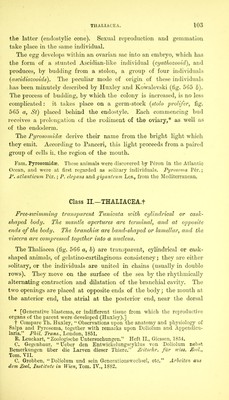
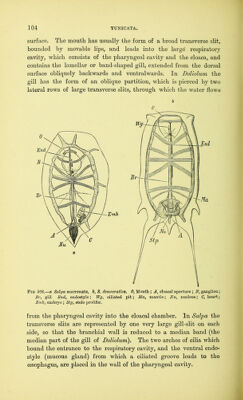
![the latter (endostylio cone). Sexual reproduction and gemmation take place in the same individual. The egg develops within an ovarian sac into an embryo, which has the form of a stunted Ascidian-like individual (cyathozooid), and produces, by budding from a stolon, a group of four individuals (ascidiozooicls). The peculiar mode of origin of these individuals has been minutely described by Huxley and Kowalevski (tig. 5G5 b). The process of budding, by which the colony is increased, is no less complicated: it takes place on a germ-stock (stolo prolifer, fig. 565 a, St) placed behind the endostyle. Each commencing bud receives a prolongation of the rudiment of the oviary,* as well as of the endoderm. The Pyrosomidce derive their name from the bright light which they emit. According to Panceri, this light proceeds from a paired group of cells ii_ the region of the mouth. Fam. Pyrosomidae. These animals were discovered by P4ron in the Atlantic Ocean, and were at first regarded as solitary individuals. Pgrosoma P6r.; P. atlanticum Per.; P. deg ans and giganteum Les., from the Mediterranean. Class II.—THALIACEA.f Free-siuimming transparent Tunicata with cylindrical or cash- shaped body. The mantle apertures are terminal, and at opposite ends of the body. The branchice are band-shaped or lamellar, and the viscera are compressed together into a nucleus. The Thaliacea (fig. 566 a, b) are transparent, cylindrical or cask- shaped animals, of gelatino-cartilaginous consistency; they are either solitary, or the individuals are united in chains (usually in double rows). They move on the surface of the sea by the rhythmically alternating contraction and dilatation of the branchial cavity. The two openings are placed at opposite ends of the body; the mouth at the anterior end, the atrial at the posterior end, near the dorsal * [Generative blastema, or indifferent tissue from which the reproductive organs of the parent were developed (Huxley).] f Compare Th. Huxley, “ Observations upon the anatomy and physiology of Salpa and Pvrosoma, together with remarks upon Doliolum and Appendicu- laria.” Phil. Irans., London, 1851. R. Leuckart, “Zoologische Untersuchungen.” Heft II., Giessen, 1854. C. Gegenbaur, “ Ueber den Entwickelungscyklus von Doliolum neb«t Bemerkungen über die Larven dieser Thiere.” Zeitsehr. für it iss. Zool., Tom. YJI. C. Grobben, “Doliolum und sein Generationswechsel, etc.” Arbeiten aus dem Zool. Institute in Wien, Tom. IV., 1SS2.](https://iiif.wellcomecollection.org/image/b2813378x_0105.jp2/full/800%2C/0/default.jpg)