Elementary text-book of zoology. Special part: Mollusca to man / by C. Claus ; translated and edited by Adam Sedgwick ; with the assistance of F.G. Heathcote.
- Carl Friedrich Wilhelm Claus
- Date:
- 1897
Licence: Public Domain Mark
Credit: Elementary text-book of zoology. Special part: Mollusca to man / by C. Claus ; translated and edited by Adam Sedgwick ; with the assistance of F.G. Heathcote. Source: Wellcome Collection.
205/356 page 203
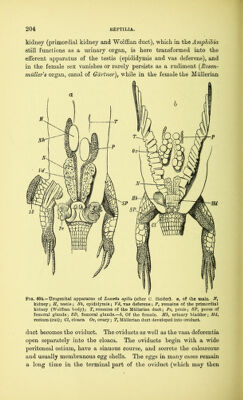
![ventricle or ventricles, and not one only as in the Ichthyopsida]. In the Snakes and Lizards the left arterial trunk is prolonged into the left aortic root without giving off vessels (fig. 60, Aos), while the right and larger before being prolonged into the right aortic root gives off a common stem for the two carotids (fig. 60, l), between which and the corresponding aortic roots a connecting vessel (ductus Botalli), constituting a second persistent aortic arch, may be retained (many Lizards). In the Chelonia the right aortic arch likewise gives off the carotids and subclavians, while the left gives off the visceral arteries. In consequence of the very small size of the aortic root of the latter, the aorta appears to be mainly a prolongation of the right aortic arch. Crocodiles present the same arrangements, but in them the right arterial trunk arises from the left ventricle and receives arterial blood from the latter. In this case also, in spite of the complete division of the heart, the mixture of venous and arterial blood is not wholly avoided, since there is a communication—the foramen Panizzce—between the right and left aortic arches. When the separation of the two ventricles is incomplete, mixture of the two kinds of blood takes place in part in the heart, although the entrance into the pulmonary vessels can by special valvular arrangements be separated from the ostia of the arterial trunks in such a manner that the arterial blood principally fiows into the latter, and the venous into the former (Brücke). In the venous system there is, as in the Amphibia, a renal-portal as well as an hepatic-portal circulation. In the Chelonia and Crocodilia, however, the renal-portal system is more and more reduced, for the greater part of the blood of the iliac veins passes to the liver. The system of lymphatic vessels presents extraordinarily numerous and wide lymph spaces, and is arranged exactly like that of the Amphibia. Contractile lymph hearts have only been discovered in the posterior part of the body at the junction of the trunk and tail. They are paired and situated on the transverse processes or ribs. The kidneys of Beptiles belong, as in Birds and Mammals, to the hinder region of the trunk, and correspond accordingly only to the posterior broad part of the Amphibian kidney. In Lizards and Chelonians a urinary bladder projects on the anterior wall of the cloaca. The urine is not by any means always fluid, but is often a whitish mass of firm consistency, and contains uric acid. The generative organs (fig 634) resemble those of Birds. The morphological relations of the generative organs of the higher vertebrates are attained, inasmuch as the anterior region of the](https://iiif.wellcomecollection.org/image/b2813378x_0205.jp2/full/800%2C/0/default.jpg)