Elementary text-book of zoology. Special part: Mollusca to man / by C. Claus ; translated and edited by Adam Sedgwick ; with the assistance of F.G. Heathcote.
- Carl Friedrich Wilhelm Claus
- Date:
- 1897
Licence: Public Domain Mark
Credit: Elementary text-book of zoology. Special part: Mollusca to man / by C. Claus ; translated and edited by Adam Sedgwick ; with the assistance of F.G. Heathcote. Source: Wellcome Collection.
210/356 page 208
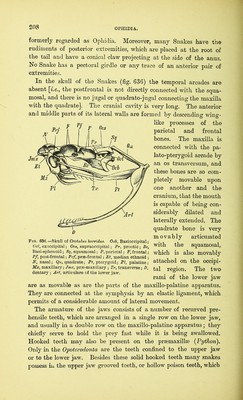
![formerly regarded as Ophidia. Moreover, many Snakes have the rudiments of posterior extremities, which are placed at the root of the tail and have a conical claw projecting at the side of the anus. No Snake has a pectoral girdle or any trace of an anterior pair of extremities. In the skull of the Snakes (fig. 636) the temporal arcades are absent [i.e., the postfrontal is not directly connected with the squa- mosal, and there is no jugal or quadrato-jugal connecting the maxilla with the quadrate]. The cranial cavity is very long. The anterior and middle parts of its lateral walls are formed by descending wing- like processes of the parietal and frontal bones. The maxilla is connected with the pa- lato-pterygoid arcade by an os transversum, and these bones are so com- pletely movable upon one another and the cranium, that the mouth is capable of being con- siderably dilated and laterally extended. The quadrate bone is very m o v a b 1 y articulated v i». uou.—ORUU UL wvvuvws riurruiux. kjco, BasiUCUipitai; . , . Ocl, exoccipital; Ocs, supraoccipital; Pr, prootic ; JBs, Wltil tne squamosal, Basi-sphenoid; Sq, squamosal; P, parietal; F, frontal; which is also movablv Pf, post-frontal; Prf, prae-frontal; Et, median ethnoid ; . ; N, nasal; Qu, quadrate; Ft, pterygoid; PI, palatine; attached On the OCCipi- Mx, maxillary; Jmx, prae-maxillary ; Tr, transverse; D, region. The two dentary; Art, articulare of the lower jaw. . ® rami of the lower jaw are as movable as are the parts of the maxillo-palatine apparatus. They are connected at the symphysis by an elastic ligament, which permits of a considerable amount of lateral movement. The armature of the jaws consists of a number of recurved pre- hensile teeth, which are arranged in a single row on the lower jaw, and usually in a double row on the maxillo-palatine apparatus; they chiefly serve to hold the prey fast while it is being swallowed. Hooked teeth may also be present on the prsemaxillse (Python). Only in the Opoterodonta are the teeth confined to the upper jaw or to the lower jaw. Besides these solid hooked teeth many snakes possess in the upper jaw grooved teeth, or hollow poison teeth, which](https://iiif.wellcomecollection.org/image/b2813378x_0210.jp2/full/800%2C/0/default.jpg)