Elementary text-book of zoology. Special part: Mollusca to man / by C. Claus ; translated and edited by Adam Sedgwick ; with the assistance of F.G. Heathcote.
- Carl Friedrich Wilhelm Claus
- Date:
- 1897
Licence: Public Domain Mark
Credit: Elementary text-book of zoology. Special part: Mollusca to man / by C. Claus ; translated and edited by Adam Sedgwick ; with the assistance of F.G. Heathcote. Source: Wellcome Collection.
66/356 page 64
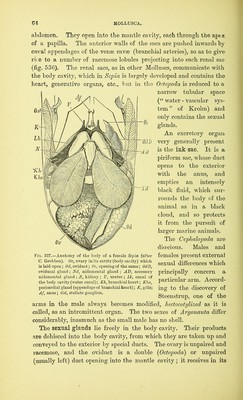
![abdomen. They open into the mantle cavity, each through the ape* of a papilla. The anterior walls of the sacs are pushed inwards by caecal appendages of the venae cavae (branchial arteries), so as to give- rite to a number of racemose lobules projecting into each renal sac (fig. 536). The renal sacs, as in other Molluscs, communicate with the body cavity, which in Sepia is largely developed and contains the Octopoda is reduced to a narrow tubular space (“ water - vascular sys- tem ” of Krohn) and only contains the sexual glands. An excretory organ very generally present is the ink sac. It is a piriform sac, whose duct opens to the exterior with the anus, and empties an intensely black fluid, which sur- rounds the body of the animal as in a black cloud, and so protects it from the pursuit of larger marine animals. The Cephalopoda are dioecious. Males and females present external sexual differences which principally concern a particular arm. Accord- ing to the discovery of Steenstrup, one of the arms in the male always becomes modified, hectocotylized as it is called, as an intromittent organ. The two sexes of Argonauta differ considerably, inasmuch as the small male has no shell. The sexual glands lie freely in the body cavity. Their products are dehisced into the body cavity, from which they are taken up and conveyed to the exterior by special ducts. The ovary is unpaired and racemose, and the oviduct is a double (Octopoda) or unpaired (usually left) duct opening into the mantle cavity; it receives in its heart, generative organs, etc., but in the Fig. 537.—Anatomy of the body of a female Sepia (after C. Grobben). Ov, ovary in its cavity (body cavity) which is laid open; Od, oviduct; Oe, opening of the same; OdD, oviducal gland; Nd, nidamental gland ; AD, accessory nidamental gland ; A, kidney : U, ureter ; Lk, canal of the body cavity (water canal); Kh, branchial heart; Klia, pericardia] gland (appendage of branchial heart); K, gills; Af, anas; Gst, stellate ganglion.](https://iiif.wellcomecollection.org/image/b2813378x_0066.jp2/full/800%2C/0/default.jpg)