Elementary text-book of zoology. Special part: Mollusca to man / by C. Claus ; translated and edited by Adam Sedgwick ; with the assistance of F.G. Heathcote.
- Carl Friedrich Wilhelm Claus
- Date:
- 1897
Licence: Public Domain Mark
Credit: Elementary text-book of zoology. Special part: Mollusca to man / by C. Claus ; translated and edited by Adam Sedgwick ; with the assistance of F.G. Heathcote. Source: Wellcome Collection.
68/356 page 66
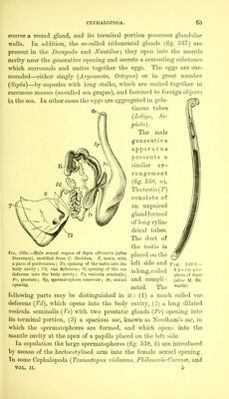
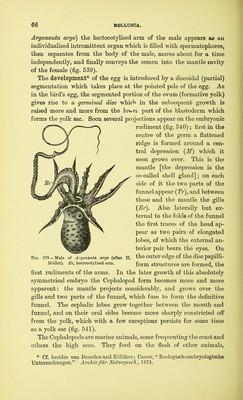
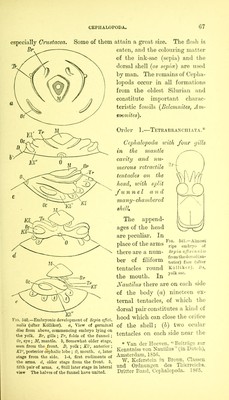
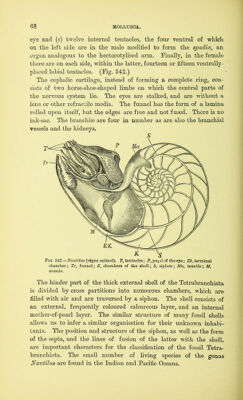
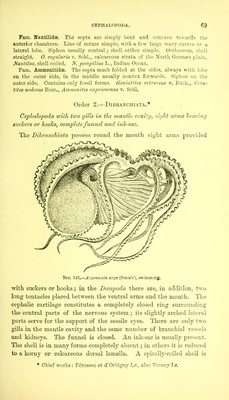
![Argonauta argo) the hectocotylised arm of the male appears a3 an individualized intromittent organ which is filled with spermatophores, then separates from the body of the male, moves about for a time independently, and finally conveys the semen into the mantle cavity of the female (fig. 539). The development* of the egg is introduced by a discoidal (partial) segmentation which takes place at the pointed pole of the egg. As in the bird’s egg, the segmented portion of the ovum (formative yolk) gives rise to a germinal disc which in the subsequent growth is raised more and more from the lowei part of the blastoderm which forms the yolk sac. Soon several projections appear on the embryonic rudiment (fig. 540); first in the centre of the germ a flattened ridge is formed around a cen- tral depression (if) which it soon grows over. This is the mantle [the depression is the so-called shell gland]; on each side of it the two parts of the funnel appear (Tr), and between these and the mantle the gills (Br). Also laterally but ex- ternal to the folds of the funnel the first traces of the head ap- pear as two pairs of elongated lobes, of which the external an- terior pair bears the eyes. On the outer edge of the disc papilli- form structures are formed, the first rudiments of the arms. In the later growth of this absolutely symmetrical embryo the Cephalopod form becomes more and more apparent: the mantle projects considerably, and grows over the gills and two parts of the funnel, which fuse to form the definitive funnel. The cephalic lobes grow together between the mouth and funnel, and on their oral sides become more sharply constricted off from the yolk, which with a few exceptions persists for some time as a yolk sac (fig. 541). The Cephalopods are marine animals, some frequenting the coast and others the high seas. They feed on the flesh of other animals, * Cf. besides van Beneden and Kölliker; Ussow, “ Zoologisch-embryologische Untersuchungen.” Archiv für Naturgesch., 1874.](https://iiif.wellcomecollection.org/image/b2813378x_0068.jp2/full/800%2C/0/default.jpg)