Life in Brazil, or, A journal of a visit to the land of the cocoa and the palm : with an appendix, containing illustrations of ancient South American arts in recently discovered implements and products of domestic industry, and works in stone, pottery, gold, silver, bronze, etc. / by Thomas Ewbank.
- Thomas Ewbank
- Date:
- 1856
Licence: Public Domain Mark
Credit: Life in Brazil, or, A journal of a visit to the land of the cocoa and the palm : with an appendix, containing illustrations of ancient South American arts in recently discovered implements and products of domestic industry, and works in stone, pottery, gold, silver, bronze, etc. / by Thomas Ewbank. Source: Wellcome Collection.
468/488 page 460
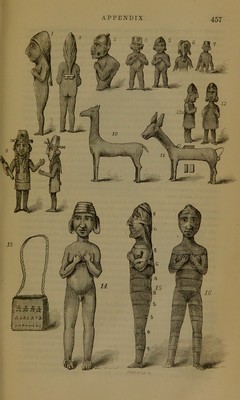
![tally, like those of the Boto-Cudos in the preceding figure. The Chirivioncs of Paraguay, as well as Brazilian tribes, still wear them; in fact, they form quite an item in the early accounts of the Amazons. Jasper lip-jewels are noted by early travelers, some of whom, when they first beheld the openings in the under lips, imagined they had found men with two mouths. A modern founder would be puzzled to cast complete—that is, without the ap- jilication of a file, chisel, or other tool after the articles had left the sand—such things as figure I and A 1, page 453, and figure 8, page 457—to say nothing of oth- ers still more intricate. It is very evident that the most elaborate works in metal were solely produced by the crucible, hammer, and abrasion, to which the blow- ])ipe in soldering, and the process of chasing must be added. The secret lies in <ine word—'patterns of wax. These, plain or intricate in detail, were modeled by hand, and buried in moulds of plaster or clay, which, when dried, were heated, the wax run out, and its place filled with molten metal. Inlaid material was imbedded in the waxen type, and thereby became imbedded in the metal. This explanation accords with every ancient piece of work. It removes every difficulty, and is the only one that does. Specimens of carving by modern Peruvians are subjoined. Figures 1 and 2 are .spoons, each cut out of one piece of wood. Figure 3 is one of their knives. The blade, hammered out of hoop-iron, was secured in a slit in the haft by strong cot- ton twine. It is not unusual for Peruvian Indians to pass over into the southwest- ern provinces of Brazil with little ventures of carved wood. The specimens fig- ured were purchased from one of the traveling artists.](https://iiif.wellcomecollection.org/image/b2488313x_0468.jp2/full/800%2C/0/default.jpg)




 No text description is available for this image
 No text description is available for this image
 No text description is available for this image