Diseases of the nose and throat, comprising affections of the trachea and oesophagus / by Sir St. Clair Thomson.
- Thomson, St. Clair, 1859-1943
- Date:
- 1912
Licence: In copyright
Credit: Diseases of the nose and throat, comprising affections of the trachea and oesophagus / by Sir St. Clair Thomson. Source: Wellcome Collection.
Provider: This material has been provided by Royal College of Physicians, London. The original may be consulted at Royal College of Physicians, London.
79/866 page 55
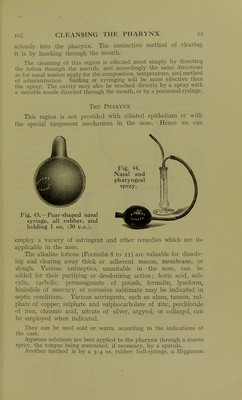
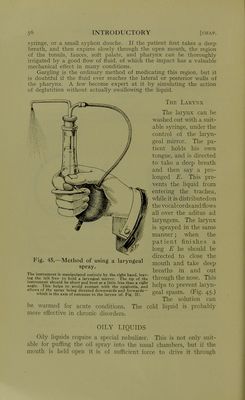
![in] sciously into the pharynx. The instinctive method of clearing it is by hawking through the mouth. The cleansing of this region is effected most simply by directing the lotion through the nostrils, and accordingly the same directions as for nasal washes apply for the composition, temperature, and method of administration. SnifEng or syringing will be more effective than the spray. The cavity may also be reached directly by a spray with a suitable nozzle directed through the mouth, or by a postnasal syringe. The Pharynx This region is not provided with cihated epithehum or with the special turgescent mechanism in the nose. Hence we can employ a variety of astringent and other remedies which are in- apphcable in the nose. The alkaline lotions (Formulae 8 to ii) are valuable for dissolv- ing and clearing away thick or adherent mucus, membrane, or slough. Various antiseptics, unsuitable in the nose, can be added for their purifying or deodorizing action; boric acid, sali- cyhc, carbolic, permanganate of potash, formalin, lysoform, biniodide of mercury, or corrosive sublimate may be indicated in septic conditions. Various astringents, such as alum, tannin, sul- phate of copper, sulphate and sulphocarbolate of zinc, perchloride of iron, chromic acid, nitrate of silver, argyi-ol, or collargol, can be employed when indicated. They can be used cold or warm, according to the indications of the case. Aqueous solutions are best applied to the pharynx through a coarse spray, the tongue being restrained, if necessary, by a spatula. Another method is by a 3-4 oz. rubber ball-syringe, a Higginson](https://iiif.wellcomecollection.org/image/b23984478_0079.jp2/full/800%2C/0/default.jpg)