Annual report of the Director of Public Health for the Government of Bombay.
- Bombay (India : State). Public Health Department.
- Date:
- [1935]
Licence: Public Domain Mark
Credit: Annual report of the Director of Public Health for the Government of Bombay. Source: Wellcome Collection.
20/250 (page 10)
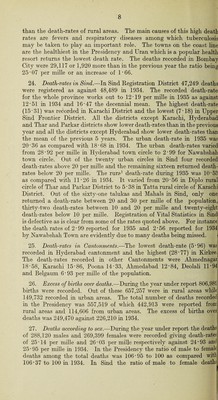
![than the death-rates of rural areas. The main causes of this high death rates are fevers and respiratory diseases among which tuberculosis may be taken to play an important role. The towns on the coast line are the healthiest in the Presidency and Uran which is a popular health resort returns the lowest death rate. The deaths recorded in Bombay City were 29,117 or 1,920 more than in the previous year the ratio being 25*07 per mille or an increase of 1*66. 24. Death-rates in Sind.—In Sind Registration District 47,249 deaths were registered as against 48,489 in 1934. The recorded death-rate for the whole province works out to 12*19 per mille in 1935 as against 12*51 in 1934 and 16*47 the decennial mean. The highest death-rate (15*31) was recorded in Karachi District and the lowest (7*18) in Upper Sind Frontier District. All the districts except Karachi, Hyderabad and Thar and Parkar districts show lower death-rates than in the previous year and all the districts except Hyderabad show lower death-rates than the mean of the previous 5 years. The urban death-rate in 1935 was 20*36 as compared with 18*68 in 1934. The urban death-rates varied from 28 * 92 per mille in Hyderabad town circle to 2*99 for Nawabshah town circle. Out of the twenty urban circles in Sind four recorded death-rates above 20 per mille and the remaining sixteen returned death- rates below 20 per mille. The rura1 death-rate during 1935 was 10*53 as compared with 11*26 in 1934. It varied from 20*56 in Diplo rural circle of Thar and Parkar District to 5 * 38 in Tatta rural circle of Karachi District. Out of the sixty-one talukas and Mahals in Sind, only one returned a death-rate between 20 and 30 per mille of the population, thirty-two death-rates between 10 and 20 per mille and twenty-eight death-rates below 10 per mille. Registration of Vital Statistics in Sind is defective as is clear from some of the rates quoted above. For instance the death rates of 2 * 99 reported for 1935 and 2*56 reported for 1934 by Nawabshah Town are evidently due to many deaths being missed. 25. Death-rates in Cantonments.—The lowest death-rate (5*96) was recorded in Hyderabad cantonment and the highest (28*77) in Kirkee, The death-rates recorded in other Cantonments were Ahmednagai 18*58, Karachi 15*86, Poona 14*33, Ahmedabad 12*84, Deolali 11 * 94 and Belgaum 6 * 93 per mille of the population. 26. Excess of births over deaths.—During the year under report 806,981 births were recorded. Out of these 657,257 were in rural areas whik 149,732 recorded in urban areas. The total number of deaths recorded in the Presidency was 557,519 of which 442,913 were reported from rural areas and 114,606 from urban areas. The excess of births oveil deaths was 249,470 against 226,210 in 1934. 27. Deaths according to sex.—During the year under report the deaths of 288,120 males and 269,399 females were recorded giving death-rates] of 25*14 per mille and 26*03 per mille respectively against 24*93 andj 25*95 per mille in 1934. In the Presidency the ratio of male to femakj deaths among the total deaths was 106*95 to 100 as compared with 106*37 to 100 in 1934. In Sind the ratio of male to female deaths](https://iiif.wellcomecollection.org/image/b31405319_0020.jp2/full/800%2C/0/default.jpg)