Studies in Japanese "kakké" or beriberi / by Wallace Taylor.
- Taylor, Wallace W.
- Date:
- 1886
Licence: Public Domain Mark
Credit: Studies in Japanese "kakké" or beriberi / by Wallace Taylor. Source: Wellcome Collection.
Provider: This material has been provided by London School of Hygiene & Tropical Medicine Library & Archives Service. The original may be consulted at London School of Hygiene & Tropical Medicine Library & Archives Service.
25/54 (page 19)
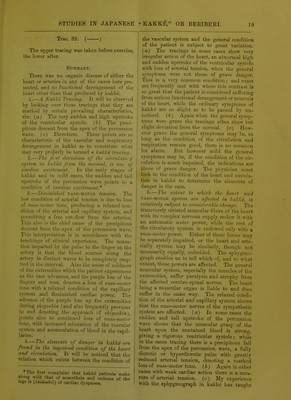
![Trac. 39. ( ) Tlie upper tracing was taken before exercise, the lower after. Summary. There was no organic disease of either the heart or arteries in any of the cases here pre- sented, and no functional derangement of the heart otlier tlian that produced by kakke. 1.—A Kakke Tracing. It will be observed by looking over tliese tracings that they are marked by certain prevailing characteristics, viz: (a) The very suHden and high upstroke of the ventricular systole, {b) The preci- pitous descent from the apex of the percussion wave, {c) Dicrotism. These points are so characteristic of the vascular and respiratory derangement in kakke as to constitute what may very proj^erly be termed a kakke tracing. '2.—2'/ie first deviation of the circulatoiy system in kakke from the normal, is one of cardiac excitement. In the early stages of kakke and in inild cases, the sadden and tall upstroke of the percussion wave points to a condition of cardiac excitement.* 3.—Diminished vaso-motor tension. The low condition of arterial tension is due to loss of vaso motor tone, producing a relaxed con- dition of the arterial and capillary system, and permitting a free out-liow from the arteries. This also is the chief cause of the precipitous descent from the apex of the percussion wave. Til is interpretation is in accordance with the teachings of clinical experience. The sensa- tion imparted by the pulse to the tinger on the artery is that the blood courses along the artery in distinct waves to be completely emp- tied in the interval. Also the sense of coldness of the extremities which the patient experiences as the case advances, and the purple hue of the fingers and toes, denotes a loss of vaso-motor tone with a relaxed condition of the capillary system and diminished cardiac power. The advance of the pur],)le hue up the extremities during shiyoshin (and also frequently previous to and denoting the approach of shiyoshin), points also to continued loss of vaso-motor tone, with increased relaxation of the vascular system and accumulation of blood in the capil- laries. 4.— The elements of danqer in kakke are found in the impaired condition of the heart and circulation. It will be noticed that the relation which exists between the condition of The first complaint that kakk6 patients make along with that of anaesthsia and oedema of the lega IB (^ikidoshii) of cardiac dyspnoea. the vascular system and the general condition of the patient is subject to great variation, (a) The tracings in some cases show very irregular action of the heart, an abnormal high and sudden upstroke of the ventricular systole with loss of arterial tension, when the general symptoms were not those of grave danger. This is a very common condition ; and cases are frequently met with where this contrast is so great that the patient is considered suffering fi'om serious functional derangement or neurosis of the heart, while the ordinary symptoms of kakke are so slight as to be passed by un- noticed, (b) Again when the general symp- toms were grave the tracings often show but slight deviation from the normal, (c) How- ever grave the general symptoms may be, so long as the condition of the circulation and respiration remain good, there is no occasion for alarm. But however mild the general symptoms may be, if the condition of the cir- culation is much impaired, the indications are those of grave danger. The physician must look to the condition of the heart and circula- tion in kakke to determine the elements of danger in the case. 5.—The extent to which the heart and VAso-MOTOK systein are affected in kakke, is relatively subject to considerable change. The transversly striated muscular fibers of the heart with its complex nervous supply endow it with an automatic motor power, wliile the rest of the circulatory system is endowed only with a vaso-motor power. Either of these forces may be separately impaired, or the heart and arte- rially system may be similarly, though not necessarily equally, enfeebled. The spliygnio- graph enables us to tell which of, and to what extent, these powers are affected. The general muscular system, especially the muscles of the extremities, suffer paralysis and atrophy from the affected cerebro-spinal nerves. The lieart being a muscular organ is liable to and does suffer in the same way. The relaxed condi- tion of the arterial and capillary system shows that the vaso-motor nerves of the sympathetic system are affected, (a) In some cases the sudden and tall upstroke of the percussion wave shows that tlic muscular grasp of the heart upon the contained blood is strong, giving a vigorous ventricular systole; while in the same tracing there is a precipitous fall from the apex of the percussion wave, a fully dicrotic or hyperdicrotic pulse with greatly reduced arterial tension, denoting a marked loss of vaso^iotor tone, (i) Again in other cases with weak cardiac action there is a meiv- sure of arterial tension, (c) My experience with the sphygmograph in kakke has taught](https://iiif.wellcomecollection.org/image/b24400646_0025.jp2/full/800%2C/0/default.jpg)