The annual report on the health of the Borough for the year1926.
- Kensington (London, England). Royal Borough.
- Date:
- [1927]
Licence: Attribution-NonCommercial 4.0 International (CC BY-NC 4.0)
Credit: The annual report on the health of the Borough for the year1926. Source: Wellcome Collection.
51/102 page 51
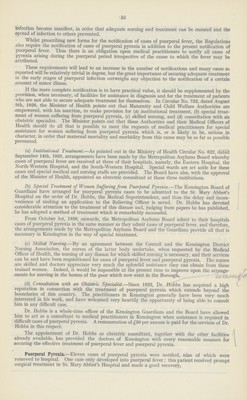
![51 injections. In a few rare instances three and even four series of injections have been necessary before the person developed immunity to diphtheria as indicated by the Schick test. This may be compared with the inspection of vaccinations; unless a vaccination is inspected about the eighth or ninth day, there is no proof that the vaccination has been successful. This method of testing and immunisation was put into practice in New York by Park in 1913, and since then some 50,000 school children have been treated in that City. It is noteworthy that 90 per cent. of those have remained immune to diphtheria after seven years. In this country the Ministry of Health have carried out extensive tests, and have introduced this form of immunisation into fourteen residential schools. The Medical Officers of the Ministry have tested 4,528 children, and have immunised 1,400. Among the former there were 265 cases of diphtheria before immuni sation but during the year following this treatment, there were only two cases. In Edinburgh some 4,000 school children have been treated by the Sanitary Authority, and the method has been widely practised in the fever hospitals of Manchester and Birmingham. In the Metropolitan Borough of Holborn, since 1922, immunisation work has been carried out for children under school age attending the Maternity and Child Welfare Centre; the number tested was 642, of which 460 were positive, and 172 were negative or immune; ten did not attend for the test to be inspected. The Royal Borough Council have intimated to medical men in Kensington that they are prepared to provide apparatus and materials for the application of the Schick test in institu tions, schools, boarding-houses, etc., but throughout the year no requests were received for this form of assistance. At the time of writing, the nursing staff at St. Mary Abbot's Hospital are being tested and immunised against diphtheria, and there is no doubt that the time is now ripe for making this pre ventive measure more readily available for the child population. Consideration should be given as to whether it might be carried out at Maternity and Child Welfare Centres, as children under the age of five years are the most susceptible to diphtheria, and are those most likely to die from it. Enteric Fever.—Thirty cases of this disease were notified, 16 being removed to hospital and 5 to nursing homes. The cases notified in the three preceding years were 12, 29 and 29. There were two deaths from this cause against 2, 3 and 3 in the preceding years. Two of the notified cases were afterwards certified not to be suffering from enteric fever or any other notifiable disease. Of the remaining 28 cases, 16 were notified from the southern division of the Borough and 12 came from North Kensington. This heavier incidence in South Kensington is not usual with other infectious diseases, and it is probably accounted for by the facts that the water supply and sanitary arrangements in London generally are very good and that a large number of persons contracting typhoid fever are infected outside the Metropolis. It will be admitted that the residents in the southern portion of the Borough leave the London area more frequently than those in the north and, consequently, are more exposed to infection by reason of the fact that many outside London districts do not enjoy the same sanitary efficiency. In seven cases there was evidence that the disease had been contracted abroad; in one case the infection was contracted in Ireland and in another case in Scotland Five patients had paid visits to places in the country a short time prior to the date of attack. The remaining fourteen had not been out of London for some time before the illness; amongst these there was a history of having partaken of fried fish in one case and of watercress in two cases shortly before the date of onset. Four of the cases were notified as paratyphoid fever. Erysipelas.—Sixty-nine cases were notified during the year, 25 of which were removed to hospital. There were 5 deaths from this cause, the deaths in the three preceding years being 4, 1 and 5. Ophthalmia Neonatorum.—The following table gives particulars of ophthalmia cases notified in 1926 and the results of treatment. ]Case No. Age of child on receipt of notification. Eyes affected. Where treated. Result of treatment. 1. 6 days Left Hospital Recovered. No injury to sight. 2. 6 „ Both „ „ „ „ 3. 18 „ Right „ „ „ „ 4. 13 „ Both Home „ „ „ 5. 6 weeks Both Hospital „ „ „ 6. 5 days Both Nursing Home „ „ „ 7. 12 „ Right Maternity Home „ „ „ 8. 3 „ Both Home „ „ „ 9. 1 month Left „ „ „ „ 10. 3 weeks Right „ „ „ „ 11. 3 days Both Hospital „ „ „ 12. 2 weeks Right „ i„ „ „ 13. 7 days Both Home „ „ „ 14. 3 weeks Left Hospital „ „ „ 15. 16 days Left Home „ „ „](https://iiif.wellcomecollection.org/image/B18222006_0051.jp2/full/800%2C/0/default.jpg)