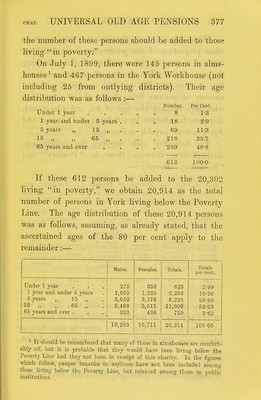
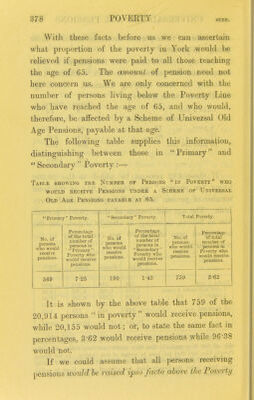
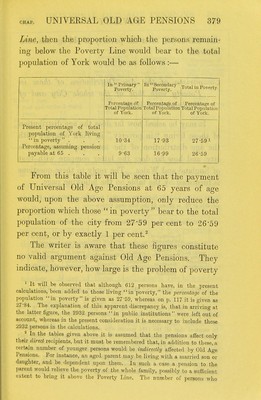
Licence: In copyright
Credit: Poverty : a study of town life / by B. Seebohm Rowntree. Source: Wellcome Collection.
Provider: This material has been provided by London School of Hygiene & Tropical Medicine Library & Archives Service. The original may be consulted at London School of Hygiene & Tropical Medicine Library & Archives Service.
406/460 page 380
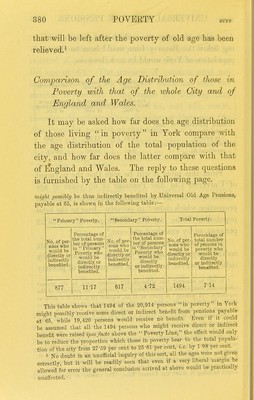
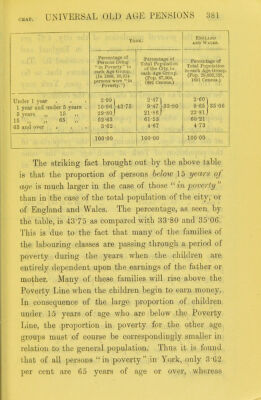
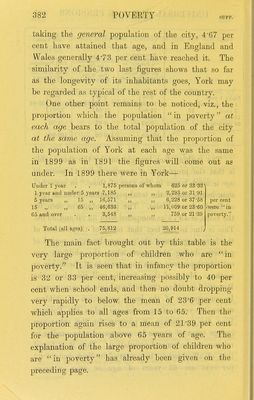
![that will be left after the poverty of old age has been relieved.^ Comparison of the Age Distribution of those in Poverty with that of the ivhole City and of England and Wales. It may be asked how far does the age distribution of those living in poverty in York compare with the age distribution of the total population of the city, and how far does the latter compare with that of ]?ngland and Wales. The reply to these questions is furnished by the table on the following page. mighl possibly be thus indirectly benefited by Universal Old Age Pensions, payable at 65, is shown in the following table:— Primary Poverty. Secondary Poverty. Total Poverty. No. of per- sons who would be directly or indirectly benefited. Percentage of the total num- ber of persons in Primary Poverty who would be directly or indirectly benefited. No. of per- sons who would be directly or indirectly benefited. Percentage of the total num- ber of persons in Secondary Poverty who would be directly or indirectly benefited. No. of per- sons who would be directly or indirectly benefited. Percentage of total number of persons in poverty who would be directly or indirectly benefited. 877 11-17 617 4-72 1494 7-14 This tabk shows that 1494 of the 20,914 persons in poverty m York might possibly receive some direct or indirect benefit from pensions payable^ at°65, while 19,420 persons would receive no benefit. Even if it could be assumed that all the 1494 persons who might receive direct or indirect benefit were raised ipso facto above the Poverty Line, the effect would only be to reduce the proportion which those in poverty bear to the total popula- tion of the city from 27-59 per cent to 25-61 per cent, i.e. by 1-98 per cent. 1 No doubt in an unofficial inquiry of this sort, all the ages were not given correctly, but it will be readily seen that even if a very liberal u.argni be allowed for error the general conclusion arrived at above would be practically unaffected.](https://iiif.wellcomecollection.org/image/b21359246_0406.jp2/full/800%2C/0/default.jpg)