Licence: In copyright
Credit: Poverty : a study of town life / by B. Seebohm Rowntree. Source: Wellcome Collection.
Provider: This material has been provided by London School of Hygiene & Tropical Medicine Library & Archives Service. The original may be consulted at London School of Hygiene & Tropical Medicine Library & Archives Service.
80/460 page 54
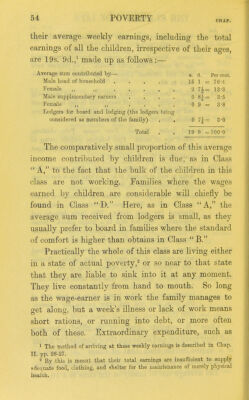
![OHAP. their average weekly earnings, including the total earnings of all the children, irrespective of their ages, are 19s. 9d.,^ made up as follows :— Average sum contributed by— g. (j. cent. Male head of household . . . , • 151 = 76-d Female , 2 7|= 13-3 Male supplementary earners . . . . 0 8|-= 3-5 Female „ .... 09=3-8 Lodgers for board and lodging (the lodgers being considered as members of the family) . . 0 7j= 3-0 Total . . 19 9 =]00'0 The comparatively small proportion of this average income contributed by children is due, as in Class A, to the fact that the bulk of the children in this class are not working. Families where the wages earned by children are considerable will chiefly be found in Class D. Here, as in Class A, the average sum received from lodgers is small, as they usually prefer to board in families where the standard of comfort is higher than obtains in Class B. Practically the whole of this class are living either in a state of actual poverty,^ or so near to that state that they are liable to sink into it at any moment. They live constantly from hand to mouth. So long- as the wage-earner is in work the family manages to get along, but a week's illness or lack of work means short rations, or running into debt, or more often both of these. Extraordinary expenditure, such as 1 The method of arriving at these weekly earnings is described in Chap. II. pp. 26-27. 2 By this is meant that their total earnings are insufficient to supply adequate food, clothing, and shelter for the maintenance of merely physical health.](https://iiif.wellcomecollection.org/image/b21359246_0080.jp2/full/800%2C/0/default.jpg)