Text-book of embryology / by Frederick Randolph Bailey and Adam Marion Miller.
- Frederick R. Bailey
- Date:
- 1911
Licence: Public Domain Mark
Credit: Text-book of embryology / by Frederick Randolph Bailey and Adam Marion Miller. Source: Wellcome Collection.
Provider: This material has been provided by the Augustus C. Long Health Sciences Library at Columbia University and Columbia University Libraries/Information Services, through the Medical Heritage Library. The original may be consulted at the the Augustus C. Long Health Sciences Library at Columbia University and Columbia University.
658/700 page 636
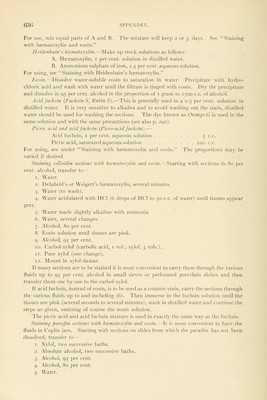
![For use, mix equal parts of A and B. The mixture will keep 2 or 3 days. See Staining with hsmatoxyUn and eosin. Heidcnhain's hccmaloxylin.—Make up stock solutions as follows: A. Ha?mato.\ylin, i per cent, solution in distilled water. B. Ammonium sulphate of iron, 2.5 per cent, aqueous solution. For using, see ''Staining with Heidcnhain's haemato.xylin. Eosin.—Dissolve water-soluble eosin to saturation in water. Precipitate with hydro- chloric acid and wash with water until the filtrate is tinged with eosin. Dry the precipitate and dissolve in 95 per cent, alcohol in the proportion of i gram to 1500 c.c. of alcohol. Acid JHchsin {Fiichsin S, Rubitt S).—This is generally used in a 0.5 per cent, solution in distilled water. It is very sensitive to alkalies and to avoid washing out the stain, distilled water should be used for washing the sections. The dye known as Orange G is used in the same solution and with the same precautions (see also p. 290). Picric acid and acid fiichsin (Picro-acid fiichsin).— .\cid fuchsin, i per cent, aqueous solution 5 c.c. Picric acid, saturated aqueous solution 100 c.c. For using, see under Staining with haemato.xylin and eosin. The proportions mav be varied if desired. Staining celloidin sections willi Iiccmato.xylin and eosin.—Starting with sections in So jjer cent, alcohol, transfer to— 1. Water. 2. Delafield's or Weigert's ha^matoxylin, several minutes. 3. Water (to wash). 4. Water acidulated with HCl (6 drops of HCI to 50 c.c. of water) until tissues appear gray. 5. ^\'ater made slightly alkaline with ammonia 6. Water, several changes. 7. Alcohol, 80 per cent. 8. Eosin solution until tissues are pink. 9. Alcohol, 95 per cent. 10. Carbol-.xylol (carbolic acid, i vol.; .xylol, 3 vols.). 11. Pure xylol (one change). 12. Mount in xylol-damar. If many sections are to be stained it is most convenient to carry them through the various fluids up to 95 per cent, alcohol in small sieves or ])crforaled porcelain dishes and then transfer them one by one to the carbol-.xylol. If acid fuchsin, instead of eosin, is to be used as a counter-stain, carry the sections through the various fluids up to and including (6). Then immerse in the fuchsin solution until the tissues are pink (several seconds to several minutes), wash in distilled water and continue the steps as given, omitting of course the eosin solution. The picric acid and acid fuchsin mixture is used in exactly the same way as the fuchsin. Staining paraffin sections with hcemato.xylin and eosin.—It is most convenient to have the fluids in Coplin jars. Starting with sections on slides from which the paratlin has not been dissolved, transfer to— 1. Xylol, two successive baths. 2. .\bsolute alcohol, two successive baths. 3. Alcohol, 95 per cent. 4. .-Mcohol, 80 per cent. 5. Water.](https://iiif.wellcomecollection.org/image/b21229478_0658.jp2/full/800%2C/0/default.jpg)